Category: Personal Growth

  • Caveman to modern human?

    Halloween is coming up, and my younger son is a bit down about not being allowed to go trick or treating. Somehow trick or treating at home with his family is not the same! Speaking of Halloween and wearing costumes, I’ve been thinking lately about how we already wear masks in our everyday lives. Just like masks hide our faces, our societal upbringing masks the truth that we are still cavemen and cavewomen living in a modern-day society.

    We are driven by some basic needs and instincts that have been hardwired into our brains. For instance, the primal drive of survival will supersede thriving or happiness any day of the week. Unlike our computer software, we cannot just change the code – not that I could change the code on any software anyway!

    As I share with my coaching clients, stop fighting these basic instincts and instead use them as a stepping stone to reach your goals or change behaviors. I remember growing up and going to the bowling alley after school some days. No matter how hard I tried, my ball would always veer left. Eventually, I realized I could just release the ball about 6 inches to the right. Then when the ball veered left, it was right at the middle of the pins. In a similar way, you can adjust your behavior knowing your caveman tendencies.

    Below I share some of the basic primal tendencies I have learned or observed as an organizational psychologist and coach.

    1.     Survival trumps happiness. Mother Nature wants her species to survive. She doesn’t care if they are happy, just that they don’t die. If left to its default operating system, your brain will choose the option that ensures survival. In modern society you don’t really need to worry about surviving, and yet you are still not focused on thriving by default. You have to be deliberate about it.

    2.     Default mode network: This is psychologists’ term for mental chatter. You are primed to plan, worry, jump from one thought to another. That’s our DEFAULT. No wonder it’s so hard to follow meditation instructions to clear your mind (BTW – we can never clear our minds, so choose a different meditation.)

    3.     In order to feel safe, we will do and choose the SAME. You are wired to feel uncomfortable trying something outside of your comfort zone. Your brain is unconsciously thinking, “Hey, if we are alive now, it must have worked so let’s keep doing it.” This is why people will sometimes stay in a job they are not happy with, instead of taking the leap with a new job.

    4.     Negativity bias: Your brain will notice what is wrong. This is another survival tendency that served humanity well living on the savannah, but is not serving you in modern-day society. Negatives will stick like Velcro, and positives will slide away like Teflon. That’s just the way humans are wired. You may have had 100 things go right in your day, but one email or conversation will throw you into a tailspin. BUT you can intentionally focus your brain on the good by prompting yourself.

    Do any of these resonate? How might you use them as a stepping stone to bring more thriving and flourishing to your life? I bring in these and more primal tendencies into every coaching conversation where it will serve the client. Reach out if I can help you or someone in your world make life easier.

    Take good care,

    Bijal

    The intent of these emails is to provide different perspectives, ideas, and insights as you navigate the path forward for yourself, your team, your organization, and your family. Sign up for my newsletter.

    October offer: Buy a package of 6 coaching sessions and receive an additional session + my 5-week online course on finding your unique strengths for free. This is a tremendous offer and is open to individuals and teams.

    Bijal Choksi, MA, CHPC, ACC

    bijal@huworkteam.com

    Let’s chat! Schedule a brainstorming session with me here

    Follow HuWork on LinkedIn

  • Soulful Sonder

    Today marks the 100th anniversary of the 19th Amendment, granting women the official right to VOTE in the US. But that didn’t mean all women in reality could vote. Many NON-WHITE WOMEN were still blocked from voting for years and even decades after 1920. Which brings us to the concept for today…SONDER.


    SONDER is the realization that each random passerby is living a life as vivid and COMPLEX as your own. Full of their own ambitions, struggles, biases, history, thoughts, families, interactions, feelings. Their own ecosystem of reality.


    How often do you think about another person’s true felt experience? How it would actually feel to look out at the world from their eyes, their version of reality? How might it have felt for those women in 1920 who tried to vote but were denied? What went through their minds? What were the different ways they reacted, internally and externally? What ripple effects did that experience have on their families and communities?


    We only know what we know. And we sure do know OUR OWN EXPERIENCE! And sometimes get wrapped up in it. It is not easy to step outside of ourselves and contemplate others’ experiences. The invitation is for you to join me in contemplating SONDER. When you see someone in your everyday life (mail person, co-worker, spouse, grocery store clerk), remember the word SONDER and reflect on their universe, their felt experience. Drop me a note and let me know if you have any aha’s.


  • Change Your Emotional State Quickly

    Growing up with two doctor parents who were trained in the eastern and western modes of healing, exposed me to many health modalities. From breathing techniques to improve lung function and the latest medicines for cancer (my dad) to supplements like Vitamin B for stress and seeds you soak overnight and then eat as a tonic (my mom).


    One technique they were not trained in that I learned a couple years ago is called EFT, or Emotional Freedom Technique. It is based on stimulating acupoints on the body’s meridians by TAPPING on them with your fingertips. With my parents’ science-based background, I was skeptical about EFT, but decided to attend a training and give it a try.


    I was BLOWN AWAY by the quick effectiveness of the technique – in less than 2 minutes, I went from STRESSED TO CALM. How many tools can do that? I know the situation causing me stress didn’t change but my emotional state did dramatically.

    I’ve since learned that there are over 100 clinical research reports published in medical journals showing EFT works. Ready to give it a try? Here’s the technique I learned:

    Say a positive statement about yourself (more details below), while you move through tapping on ~10 different spots on your body. 

    • Step 1: RATE your emotional state from 1 to 10. Don’t skip this step. 

    • Step 2: Come up with your STATEMENT by filling in the blank: “Even though I am ___________________, I love and accept myself fully.” Fill in the blank with your emotional and/or physical state, like anxious, stressed, angry, disappointed, in pain, etc. Such as “Even though I am stressed and in pain, I love and accept myself fully.”

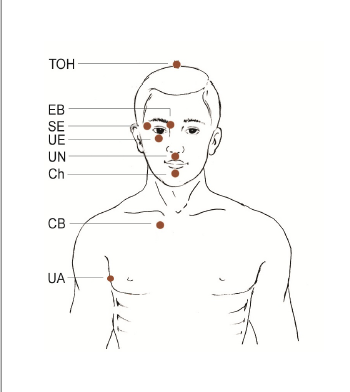
    • Step 3: Do 2 rounds of TAPPING: Start with the top of your head and move down. Below is a picture of the tapping points. (TOH = Top of Head; EB = Eyebrow; SE = Side of Eye; etc.) You will use both hands’ fingertips on the head, then your hands will tap on the points on the respective side of the body (e.g., the right hand taps on the right eyebrow while the left hand taps on the left eyebrow.) Here is a short video showing the technique.

    • Step 4: RATE your emotional state post- tapping from 1 to 10. If you are still above 5, continue tapping until your rating decreases.


    Drop me a quick note and let me know how it goes. If you want to tap with me to ensure you are doing it right, you can find a spot on my calendar. And if you know someone who is stressed and could use a coach who is knowledgeable about multiple modes of stress management, I would love an introduction. Life is short – don’t let stress negatively impact your relationships, career, and state of mind.

  • Need Small Treats?

    “One of the secrets of a happy life is continuous small treats.” – Iris Murdoch 

    Continuing on the thread of happiness, it might seem obvious but experiencing POSITIVE EMOTIONS is a key part of being happy. Positive emotions not only make us feel good, but they also improve our well-being, relationships, health, and performance. Say what? Sign me up! 


    And our positive emotions don’t have to be extreme to reap these benefits. Positive emotions such as feeling inspired, peaceful, confident, amused, accepted, optimistic….these are all DEPOSITS in our personal POSITIVE EMOTION BANK ACCOUNT. 


    So many of us go through our day, our to-do lists, our meetings, our meals, without noticing what we are feeling. This upcoming week, I invite you to NOTICE when you are experiencing positive emotions. And if you are falling short on the positive emotion deposits, think about building in small treats (maybe not always desserts like my younger son is apt to do) each day. Things that bring a smile to your face.


    I Would love to hear what is on your list of small treats. I could use some treats myself this week.

  • Upside of stress?

    We are all familiar with the dark side of stress: tight shoulders, trouble sleeping, emotional reactivity, etc., etc…but have you stopped to consider the potential BENEFITS of stress and disruption (cough “pandemic”, “societal unrest”, “social distancing”, “job loss”)? Jonathan Haidt is a social psychologist who studies exactly this phenomenon.

    While no one enjoys the struggle, I’m glad researchers are exploring the flip side of the coin to find some upside to adversity.

    The key takeaway from Jonathan is that we rarely return to our normal ways of being and behaving after a truly difficult situation. Instead we go BEYOND that…growing and learning new ways to cope…indeed new ways of being in our life.


    Based on Jonathan’s research, I invite you to take 10 minutes to:

    1)     Think about how you might have GROWN these past few months. A few ideas to get you started: developed increased flexibility with where and how you work, started new rituals for yourself, focused more on the positive, realized you could use more sleep than you used to get, are more open to different perspectives, learned how to make a latte.


    2)     Then DOCUMENT this growth somewhere. Either in a physical journal or I’m currently loving the online and FREE tool Trello which allows you to create a virtual board you can view on your phone and computer. You could create a board called “Growth” then populate it with items as you think of them.


    3)     Lastly, CELEBRATE the growth. Doesn’t have to be anything fancy (but it can be! I encourage you to go big if you’re in the mood!). But take at least a moment to recognize your effort and growth.


    In this manner you “get to write the ending” in the words of Brene Brown, and you can bounce back not just to where you were before, but to a place of greater strength. Please share your growth list with me in the comment section below. I am trying out a new format for these posts and would love to virtually celebrate and do a happy dance with you! 

    My hope is that these posts help you on your path of growth. If I can assist you on your path, professionally or personally, please schedule a 20-minute “are we a good fit?” call here.

    The intent of these posts is to provide different perspectives, ideas, and insights as you navigate the path forward for yourself, your team, your organization, and your family.