Category: Work-Life Integration

  • Happy New Year! Wishing you the very best in 2022

    After navigating ourselves, our families, and our clients through another year of a global pandemic and a variety of other challenges, we at HuWork are more motivated than ever about our mission to help talented people improve their results and their happiness, and to help organizations be the place those people want to work.  

    While it’s been a tough year on many levels, one recent challenge I faced was an unwanted Christmas present my older son and I received – omicron. Thankfully, I only experienced mild symptoms. I hope Santa, the universe, or whatever else you believe in brought you a better present!

    I was fortunate to be in Miami at the time, recuperating in warm weather near the ocean, but my husband was in Colorado. This was the first time since 1996 that I was not able to ring in the New Year, nor celebrate his birthday (he’s a new year’s baby) with him. A few things I reminded myself to be grateful for when I was feeling down about this separation were:

    • Time with my high school junior before he flies the coop: binge watching shows, researching colleges, planning meals

    • Time without obligations: meditating, journaling, just sitting and staring at the ocean, solo walks on the beach

    • Time to reflect on the year. Three questions I’m reflecting on are:

      • What are 3 moments that you LOVED in 2021?

      • What are 3 LESSONS you learned in 2021?

      • What BEAUTY in your life are you overlooking that you can appreciate in 2022?

    In addition, a book that helped my mindset was “Fierce Self-Compassion” by Kristin Neff. I highly recommend it.

    For anyone working with a team, another resource I recommend is our The Human FactorTM, an assessment we designed to help employees at all levels consider how human is my workplace? It is based on our experience and research showing that a workplace where mindsets, behaviors and policies that support people flourishing will have better business results and a positive impact on the world. You can use this assessment to spark new thinking and start meaningful conversations with your team. Or click here and we would be happy to set up time to chat about your results.

    The entire HuWork team wants to help our fellow humans navigate personal and professional challenges in 2022 and beyond. What questions are you reflecting on?  What challenges will you face in the New Year?

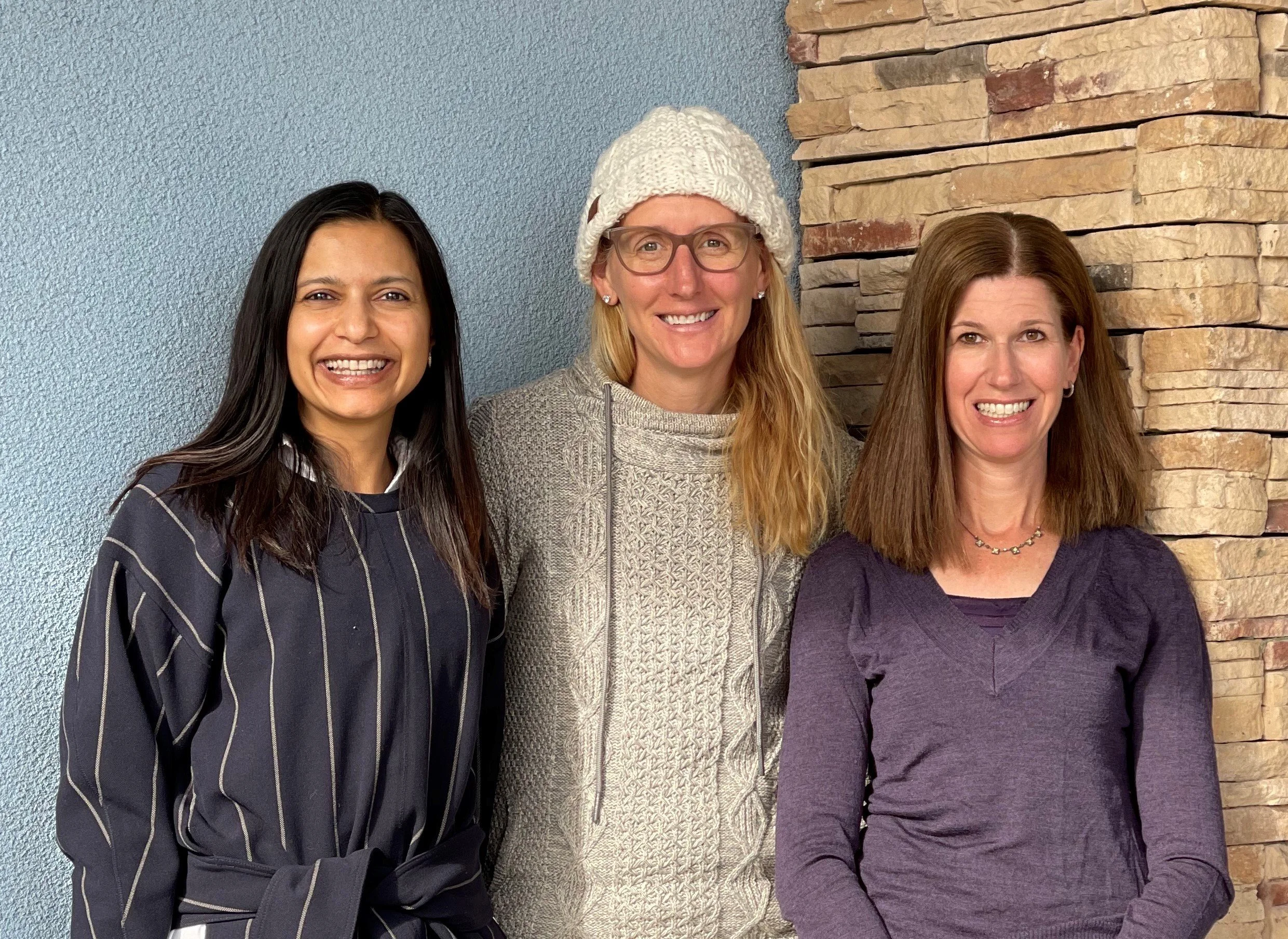
    ​​Here is a picture of me with my business partners, Liesa Wierschke Taylor and Bonnie Davis. So grateful for you both!

    Warmly, 

    Bijal

    The intent of these emails is to provide different perspectives, ideas, and insights as you navigate the path forward for yourself, your team, your organization, and your family.

    Click here if you were forwarded this email and would like to sign up to receive my emails. You may unsubscribe at any time.

    Bijal Choksi, MA, CHPC, ACC

    bijal@huworkteam.com

    Follow HuWork on LinkedIn

  • 8 types of rest this holiday

    When you hear the word REST, you may think of sleep.  And sleep indeed is important and often underappreciated. Here’s hoping we can all catch up on some sleep at the end of 2021. But have you stopped to think of other types of REST you might need, beyond the physical?

    “Rest is much more than sleep or physical relaxation” as noted on Insight Timer’s blog (Insight timer is my favorite free meditation app fyi.) Rest also includes taking a break from things every once in a while, such as from sensory overload (shopping websites, I’m talking to you!), from constantly creating or producing, from our myriad of emotions, and even from other human beings.

    The 7 types of rest included in the blog, and my addition of the 8th:

    1. Physical Rest

    2. Mental Rest

    3. Sensory Rest

    4. Creative Rest

    5. Emotional Rest

    6. Social Rest

    7. Spiritual Rest

    8. Caloric Rest: sometimes our digestive system needs a rest as well. I’m a huge fan of intermittent fasting, for its weight control but also to break up the routine of eating multiple times a day.

    With holiday gatherings in full swing, the type of rest I think I need is social. However, this Thursday would have been my dad’s 76th birthday, so I think I’ll focus on spiritual rest this week, by reconnecting with him spiritually.  

    What about you? What type of rest do you need to focus on right now?

    Warmly, 

    Bijal

    The intent of these emails is to provide different perspectives, ideas, and insights as you navigate the path forward for yourself, your team, your organization, and your family.

    Click here if you were forwarded this email and would like to sign up to receive my emails. You may unsubscribe at any time.

    Bijal Choksi, MA, CHPC, ACC

    bijal@huworkteam.com

    Follow HuWork on LinkedIn

  • An introvert’s lessons from glamping

    This past weekend, three friends and I went on a glamping adventure in the mountains of Colorado. For those not familiar with the term “glamping”, it’s a combination of “glamourous” and “camping”. Being an introvert on a weekend trip with extroverts provided a great opportunity to reflect on our group dynamics.

    Here are 4 team lessons this introvert learned from this glamping experiment:

    1. Know your NON-NEGOTIABLES: at its core, this is about knowing yourself. What are you open to? What makes you uncomfortable? Where are you willing to budge, and what is a hard no? E.g., you need coffee first thing in the morning, more than two drinks will leave you with a headache the next morning, subfreezing temps while sleeping is NOT okay. Next time I will reflect ahead of time on my non-negotiables and be prepared.

    2. Confirm EXPECTATIONS: four people; four different perspectives. How would we spend our time? Always together or is alone time okay? Planned or free flowing? Stay up late or take advantage of no responsibilities and maximize sleep? While some of this was “discussed” over a chat thread when sharing the weather forecast, in hindsight I might explicitly ask everyone (including myself!) what their expectations were in advance.

    3. Respect different PERSONALITIES: some people are extroverts and process through talking. Others are more reflective and might get drained with endless chatter. There were times I felt there was no space for me in the conversation, as the conversation free-associated and jumped from one person and story to the next without pause. This reminded me of “conversational equality”, a factor Google found was critical to high performing teams, where no one person dominates the conversation. For Google, this led to better ideas, execution and ultimately, outcomes.

    4. Know when to SPEAK UP: when there is no clear leader, as in a group camping trip, it is even more important for introverts to speak up when it’s important. E.g., with the extroverts caught up in a long conversation, and the sun starting to fade, making the effort to interrupt and suggest going for the hike then to take advantage of the sunlight.

    Do any of these lessons resonate with you, perhaps from a similar experience?

    Warmly, 

    Bijal

    The intent of these emails is to provide different perspectives, ideas, and insights as you navigate the path forward for yourself, your team, your organization, and your family.

    Click here if you were forwarded this email and would like to sign up to receive my emails. You may unsubscribe at any time.

    Bijal Choksi, MA, CHPC, ACC

    bijal@huworkteam.com

    Follow HuWork on LinkedIn

  • Effortless effort

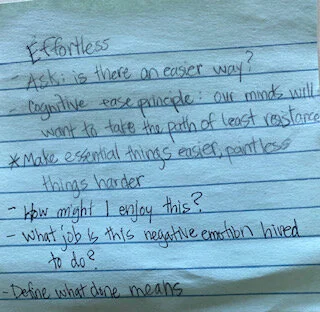
    I recently finished a book called Effortless: Make It Easier to Do What Matters Most by Greg McKeown. While finding the time to read the book did take some effort, taking time to synthesize and use the concepts is taking even more effort!

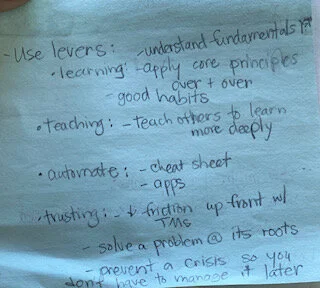
    I tried a low-tech method in response to the question, “How might I make this easier on myself?”, posed by the author. This involved using a lined post-it note to jot down key concepts, and it doubled as my bookmark. It’s not pretty, but you can see in the pictures that I was able to summarize the salient parts of the book on the sticky notes. Afterwards, it took less than a minute to take pictures of those notes and drop them into an Evernote note, for easy reference whenever needed.

    I’m currently testing out the “Automate” lever that’s on the sticky note by creating mini cheat sheets for recurring tasks. Not that I couldn’t remember the steps, but by having this cheat sheet on, you guessed it, a sticky note, it frees my mind up to be ready to make more important decisions and remember more critical information the rest of the day. 

    What is your system to document and apply what you learn from books, podcasts, or classes? I find it challenging at times to move from consumption of the material to the eventual positive impact it can have if put in place.

    Warmly, 

    Bijal

    The intent of these emails is to provide different perspectives, ideas, and insights as you navigate the path forward for yourself, your team, your organization, and your family.

    Click here if you were forwarded this email and would like to sign up to receive my emails. You may unsubscribe at any time.

    Bijal Choksi, MA, CHPC, ACC
    bijal@huworkteam.com

    Follow HuWork on LinkedIn

  • My interview on NPR

    Recently, I was interviewed for an episode of The Story of Change, a radio show on National Public Radio (WUTC). This episode focused on how one’s upbringing influences one’s relationship to change, growth and development. In it, I share some perhaps surprising (and definitely vulnerable!) bits of my history, what I feel guilty about, and my agency (or lack thereof) to initiate changes in the world today.

    You can take a listen here: (Episode 4) https://thestoryofchange.net/#listenNow 

    Would love to hear how your upbringing has influenced your relationship to change.

    Warmly, 

    Bijal

    The intent of these emails is to provide different perspectives, ideas, and insights as you navigate the path forward for yourself, your team, your organization, and your family.

    Click here if you were forwarded this email and would like to sign up to receive my emails. You may unsubscribe at any time.

    Bijal Choksi, MA, CHPC, ACC
    bijal@huworkteam.com

    Follow HuWork on LinkedIn

  • The importance of a personal Board of Advisors

    This year, I’ve had the privilege of helping facilitate a women’s circle that provided some structure to think through issues and support one another. One of our first sessions centered on the concept of developing one’s own personal BOARD OF ADVISORS. Companies engage Boards to help them make the right decisions, so why don’t we as individuals? A personal Board of Advisors is a group of respected individuals who will help you thrive. I’ve mainly applied this concept for career development, but there’s no reason it couldn’t work for health or general life improvement as well. 

    The central theme to one’s BOA is PERSONAL RELATIONSHIPS. There is a reciprocity involved; we are enriching our advisors’ lives in some way, while they are providing support to us.

    The most common question I’m asked about this concept is, “What value can I add to someone who is way ahead of me in their career?”

    Here are a few ways you can help your Board of Advisors:

    • CONNECT: Connecting people is a powerful way to help others. You can introduce them to someone to fill a need they have, or connect them to a resource such as a book or article.

    • INVITE: I have found time and again that as people gain power, they can also become more isolated. You can invite one of your board members to a new restaurant, a group happy hour, or an event you are involved with such as a non-profit fundraiser.

    • BE AN EXPERT: Catalog your own unique expertise, such as social media, knowing the newest restaurants and events, your interest in art, or whatever you are already interested and knowledgeable about. Then, when you ask your advisor what challenges they have going on, you’ll already have a few areas in which you might be able help.

    This is not a science. Your BOA will ebb and flow; but, when you are in a pickle of a situation, it is comforting to know you have people with specific expertise to whom you can turn. My advice: get started this quarter filling out the BOA template, especially the list of 5 people to be on your BOA. Reach out to each one to say hello and subtly gauge their openness to engage in conversations that matter. 

    If you are ready to get started, here is a template to help you build your own Board of Advisors. 

    Reach out if you have any questions.

    Warmly, 

    Bijal

    The intent of these emails is to provide different perspectives, ideas, and insights as you navigate the path forward for yourself, your team, your organization, and your family.

    Click here if you were forwarded this email and would like to sign up to receive my emails. You may unsubscribe at any time.

    Bijal Choksi, MA, CHPC, ACC

    bijal@huworkteam.com

    Follow HuWork on LinkedIn

  • How to channel a higher cause at work

    Looking for a motivation reboot at work or ideas on how to be an inspirational leader? I’d recommend checking out Simon Sinek’s The Infinite Game.  

    Simon takes an opposing view to Milton Friedman, the economist who posited that business’ sole responsibility is making profit. Simon argues that in addition to making profit, organizations should provide broader value to society, namely: 

    • Advance a PURPOSE: offer people a sense of belonging and a feeling that their lives and their work have value beyond the physical work

    • PROTECT people: operate our companies in a way that protects our workforce, our clients, and the work environment.

    • Generate PROFIT: money is fuel for a business to remain viable and to continue advancing the first two priorities

    According to Simon, any leader who wants to adopt this infinite mindset of running a business or team must follow five essential practices:

    1. Advance a JUST CAUSE: find a long-term cause the team can rally around

    2. Build TRUSTING teams: trust is key for engagement and collaboration

    3. STUDY your worthy rivals: keep tabs on your competition to understand the landscape

    4. Prepare for existential FLEXIBILITY: The capacity to initiate an extreme disruption to a business model or a strategic course in order to more effectively advance a just cause. 

    5. Demonstrate the COURAGE to lead: The willingness to take a risk for the good of an unknown future. Just like CVS deciding to stop selling cigarettes, even though they knew it would piss off Wall St. (BTW, the stock price only took a brief dip before recovering and gaining.)

    LEADERS especially must model the behavior they want to see, actively incentivize the kinds of behaviors that build trust, and give people the responsible freedom and the support they need to flourish in their jobs. It is a combination of what we value and how we act that sets the culture of a company. 

    CULTURE = VALUES + BEHAVIOR

    If leaders place an excess of stress on people to meet the numbers, and offer lopsided incentive structures, they risk creating an environment in which near- term performance and resources are prioritized, while long-term performance, trust, psychological safety, and the will of the people decline.

    Exhibiting the QUALITIES of leadership is what makes someone an effective leader. Qualities like honesty, integrity, courage, resiliency, perseverance, judgment and decisiveness. Ideally leaders would measure the inputs and the behaviors, rather than the outcomes.

    It’s very common for people nearing the end of their corporate careers to start foundations or distribute their wealth to charity, working to fulfill a desire to give back and do something more philanthropic. But purpose is not something that we need only find after a successful career. There are ways to infuse higher purpose in our everyday lives and work.

    Questions to ask yourself:

    • Am I just working for the money? 

    • How might I change my mindset at work to fulfill a broader goal I have? E.g,. treating people well, inspiring others to give their best, etc.

    • Should I move on to fulfill my desire to work for a cause bigger than myself?

    I’m here as a resource if you want to talk through your particular situation with a quick 20-min call. Interesting to note: about 50% of my coaching clients who originally wanted help finding a new career, end up renewed and remotivated in their existing role after a few coaching sessions. We look at how they are spending their time, what tasks they excel at, how they might improve their relationships with peers and their boss, and define their unique professional brand, leadership style, and goals.

    Warmly, 

    Bijal

    The intent of these emails is to provide different perspectives, ideas, and insights as you navigate the path forward for yourself, your team, your organization, and your family.

    Click here if you were forwarded this email and would like to sign up to receive my emails. You may unsubscribe at any time.

    Bijal Choksi, MA, CHPC, ACC

    bijal@huworkteam.com

    Follow HuWork on LinkedIn

  • Anguishing over languishing

    From the NY Times to a Professor at Wharton, it seems many people are discussing the term “languishing”. Organizational psychologist Adam Grant defines languishing as “a sense of stagnation and emptiness.” Yikes! That’s no fun, but it’s a feeling that many are experiencing with the pandemic lock downs, resulting social isolation, and the ongoing mental toll of it all.

    Even as I type this, I feel a pit in my stomach as this term rings true for me too. Not all day, every day, but certainly with some regularity.

    Here’s my 1-2-3 coping mechanism to deal with my own up and down languishing state:

    1. AWARENESS: becoming aware of what I am feeling is a necessary first step. In other words, “Name it to tame it!” How can I change things if I don’t know what I need to change? 

    2. FOCUS: it may seem counterintuitive, but taking time to focus on that feeling and acknowledge it can help it dissipate. I especially find it helpful to focus on where in the body I feel that emotion. Then, get curious about the feeling – its qualities, texture, motion, and color. What might this physical feeling need at this moment? As Brené Brown says, if you are disembodied from your emotion, it only grows. Finally, implement some actions. For me, this includes leaving my house twice a day, getting out in nature once a day, and finding ways to connect with one of my peeps daily.

    3. REFINE: alas, there is no “one and done” with many feelings, such as languishing. So  I check in weekly, and ask myself “What will help this week?” Knowing it may look different than the week before, is very helpful.

    Can anyone else relate to this languishing feeling? If so, what are your coping mechanisms?

    Warmly, 

    Bijal

    The intent of these emails is to provide different perspectives, ideas, and insights as you navigate the path forward for yourself, your team, your organization, and your family.

    Click here if you were forwarded this email and would like to sign up to receive my emails. You may unsubscribe at any time.

    Bijal Choksi, MA, CHPC, ACC

    bijal@huworkteam.com

    Follow HuWork on LinkedIn

  • Chakras in the workplace

    While I was brought up in a traditional Indian household, the cultural aspects of our heritage were emphasized more than the religious ones. So it wasn’t until a yoga class in adulthood that I learned more about chakras. 

    Even to me, chakras sound a bit “out there”, but if we move beyond the esoteric term and just think about the ideas the chakras highlight, they are very much in line with HuWork’s philosophy of work being more human, and organizations having more human-centered practices in place. I would love to hear what you think.

    Each of the 7 chakras relates to a specific concept. I have added questions that pertain to the workplace for each:

    • TRUST: Is the work culture one of trust?

    • CREATIVITY: Do you have the ability to include some creativity in your work tasks, to make them your own?

    • WISDOM: Do you have a mentor and peers you can turn to for input? Are you continuously learning so you can provide wisdom to others? How can you create some space from the daily transactional “should do’s” to think about broader goals?

    • LOVE: What type of  energy are you bringing to your team? Are you finding the good in people and what went well, or always focusing on the negative?

    • COMMUNICATION: What is your communication style? Are you a GSD-kind of leader or more inspirational? Who do you want to be?

    • AWARENESS: Where are you on your career development?  What direction would you like to go?

    • ALIGNMENT: Is your workplace aligned with your values?

    Based on how you answered these questions, what’s one change that would have an enormous impact on your worklife? For me, I realize I have a gap in the wisdom category, specifically a male mentor. Anyone interested in that role? I promise reciprocity in knowledge, trust, and help.

    Warmly,

    Bijal

    The intent of these emails is to provide different perspectives, ideas, and insights as you navigate the path forward for yourself, your team, your organization, and your family. If I can assist you on your path, please schedule a 20-minute call here. And don’t forget about my free open door OFFICE HOURS every Wednesday from 10-11am MT. All you have to do to attend is register here. The last two weeks have been lonely, so you’ll likely get 1:1 time for us to explore and brainstorm your particular situation.

    Click here if you were forwarded this email and would like to sign up to receive my emails. You may unsubscribe at any time.

    Bijal Choksi, MA, CHPC, ACC
    bijal@huworkteam.com

    Follow HuWork on LinkedIn

  • When less is more

    Pablo Picasso said art is the “elimination of the unnecessary.” However, most people will instinctually ADD versus SUBTRACT something. For example, if engagement is waning at work, a manager may increase the number of team meetings. While adding more can be a good thing (feel free to keep bringing home flowers S!)….when facing decision points, I’m starting to consider removing something as an alternative instead.

    I’m currently reading “Subtract” by Leidy Klotz, who makes a nice case for remembering that subtraction can be even more impactful than addition. In fact, I’m now a little obsessed with how life might improve with less: less complexity, less switching gears, less clutter, fewer obligations. Maybe even having fewer Clients, but going deeper with the ones that truly resonate. 

    And if the words “subtract”, “remove”, or “reduce” have a negative connotation to you, you’re not alone. Try substituting “reveal”, “clean”, “carve”, “create”, “construct”, or “streamline” to override a potential sense of loss. 

    If you want to learn more about the science and research behind our drive to add, check out this article.

    Warmly, 

    Bijal

    The intent of these emails is to provide different perspectives, ideas, and insights as you navigate the path forward for yourself, your team, your organization, and your family.

    Click here if you were forwarded this email and would like to sign up to receive my emails. You may unsubscribe at any time.

    Bijal Choksi, MA, CHPC, ACC

    bijal@huworkteam.com

    Follow HuWork on LinkedIn