Category: Uncategorized

  • Do You Have A Well-being Framework?

    Happy Friday. Today’s email focuses on a theme that came up repeatedly this week: WELL-BEING AT WORK. 

    Sherry Bahrambeygui, CEO of PriceSmart spoke about well-being in Wharton’s “Leadership in the Wake of COVID-19: What Enterprise Leaders Will Need to Survive and Prosper in the Years Ahead” webinar. And Jennifer Fisher, Chief Well-Being Officer at Deloitte & Touche (where I used to work and let me tell you this role not only did not exist then, but the whole topic of well-being was taboo in 1995!) touched on her framework for well-being during a 60-minute webinar this week. 


    Key takeaways for you:

    1. ASK YOUR EMPLOYEES & CO-WORKERS HOW THEY ARE DOING: Sherry challenged listeners by asking “How have you kept track of your staff’s well-being?” She has the head of HR present at their daily employee meetings to share resources and keep a pulse on people’s well-being. Sherry also explicitly invites her direct reports to talk about their well-being. 

      • Bijal’s organizational psychologist take: HR sharing resources during a group zoom call is great as a “push” communication, and Sherry inviting people to open up is a start, but it is CRITICAL to have regular 1:1 calls with each person that is reporting to you to find out how they are really doing. It’s up to you to guide the conversation. A team zoom call does not cut it. People may not feel psychologically safe enough in a group setting to really share how they are doing, no matter how tight you think the group is.

      • AND… there’s a fine line between checking in and caring about your employees/co-workers and becoming their therapist or coach. Invite the conversation, and continue to check in…but if it becomes an ongoing vent session, gently point out that he seems stuck, you don’t have the background to help, and here are other resources that can help, like your organization’s EAP, a coach, therapist, article, or other relevant resource. 


    1. BE A ROLE MODEL: Sherry made a decision to be vulnerable and share her own personal struggles with well-being with her team. She shared that for years, especially as a female, she felt this sense of having to be 100% in control of everything. And how she debated whether to tell her team that her father had a major health issue and the impact the situation had on her. In the end, she decided to be a role model and opened up about her struggles with well-being around both events.

      • Bijal’s take: 👍


    1. LAND ON A WELL-BEING FRAMEWORK: Deloitte’s framework for well-being is body, mind, purpose, and financial health.

      • Bijal’s take: If you don’t know where you are aiming, how will you know if you have achieved it? Whether for yourself or for your team or organization, put a stake in the ground and decide what the key components of well-being are for you. Then when you have those 1:1 conversations with your direct reports or co-workers, you can weave in each component into the conversation. Because well-being is so subjective, I would suggest a couple of additional components to Deloitte’s framework: life/work satisfaction and feelings (higher positive feelings and lower negative feelings.) If you need help figuring out a framework that works for you, please reach out. I LOVE helping clients develop customized systems and frameworks that work for them!

      • AND…if your Human Resources department is still primarily focused on the compliance side of HR, tell them to wake up and smell the coffee. The head of HR needs to be thinking about employees from a “whole-human” perspective. Deloitte’s well-being model includes body, mind, purpose, and financial health. What do you and your employees need to thrive? I would love to hear about your model for well-being.

  • How Will Companies Adapt?

    Today’s highlight is from Wharton’s “Leadership in the Wake of COVID-19: What Enterprise Leaders Will Need to Survive and Prosper in the Years Ahead”. Sherry Bahrambeygui, CEO of PriceSmart spoke about ADAPTATION.  

    As a reminder, the intent of these posts and insights are to help you plan the path forward for yourself, your teams, and your organization. If I can be of assistance to you in a coaching or consulting capacity, drop me a note.


    Highlights on adaption from Sherry:

    • #1: Demolish expectation of face time equating to doing work: Sherry believes this will change permanently. It was already an expectation with the next generation. We thought the process was going to take a while, but here we are! And Sherry urges you as leaders to shift from face time to accountability. The onus to do this is on the supervisor. 

      • Bijal’s org psychologist take: I had predicted this shift of unofficial power down the ranks to the supervisor level when companies started working from home on a mass scale. There’s simply no way for a Director, Partner, VP to stay connected with and on top of a large distributed group of people, so the direct supervisor is key. You may have heard about HSBC’s decision to cut reporting levels from seven to four. Be prepared and expect more “delayering”.

      • Side note: the skills that promoted someone to a supervisor role are NOT the skills needed to succeed as a team leader. I wrote about this last 2 weeks ago, but feel free to reach out if you want more details.


    • #2: Individualize policies: Sherry spoke about the need to customize processes to meet employees where they are. At PriceSmart, anyone who has school children can continue to stay home unless there’s a business necessity to come to the office. 

      • Bijal’s take: Bravo! Just like personalized medicine, I do believe this is the future of work for white collar jobs. Progressive companies will focus on the output and value the employee provides, not details like where the work is getting done or at what time. Adding this win to my list of thin silver linings during this pandemic. J


    I’ll end with a quote from Churchill: “Never let a good crisis go to waste.” Take time to process, reflect, and enact changes in your personal life and work. If not now, then when? If you want a safe space to explore, make changes, and plan, I’m here in your corner.

  • Tips To Bounce Back From Stress


    Happy Friday. We made it another week J As a recap, in the last email I shared 5 tips to prepare for stress: anticipate, plan, resource up, enroll, and visualize. 

    Today, let’s talk about a different aspect of resilience: how to BOUNCE BACK AFTER a stressful event. Below are 3 strategies to help you recover from a stressful event. And to really internalize the benefits, I invite you to scale yourself from 1-10 on how you feel beforeyou try a technique and again afterwards (Scale I use: 1 = I feel extremely crappy to 10 = I feel amazing). If you see an increase in your subjective emotional state of 2 points or more I’d suggest adding it to your resilience toolkit.


    3 STRATEGIES TO BOUNCE BACK FROM STRESS: 

    1. RECHARGE YOUR BODY AND NERVOUS SYSTEM: I would start with this step to calm your nervous system and recharge your batteries. Tips: Intentionally make your exhale longer than your inhale for 5 breaths to kick start the relaxation response. Get out in nature with no audio book or podcast, just let your mind be open and spacious. Do a guided stress reduction meditation. Try gentle exercise like a walk or yoga. I could go on and on, but experiment to discover what works for you. I’d love to hear what does work for you.

    2. GAIN PERSPECTIVE: When we focus on what we can’t control and what’s wrong, it can be like a pinhole in a camera – we don’t see the full picture. Try asking yourself “What could have gone worse?” “What can I be happy about, grateful for?” “How can I turn this obstacle upside down? Is there an opportunity here?” “Is there is a way to explain or interpret the situation that is more resilient?”

    3. PRACTICE SELF-COMPASSION: This is mental health month, and we often are kinder to others than we are to ourselves. Ask yourself “What advice would I give my friend if she was in this situation?” You may be surprised by what this question reveals.


    Know that I am your cheerleader here, encouraging you to start practicing these techniques RIGHT NOW with small stressors in your life. Let me be your virtual accountability partner in this area. Email me today what 1 technique you commit to try this weekend, and then let me know how it went for you.


    If someone in your world could benefit from 1:1 sessions with me, I would be honored with an introduction.

  • Test Your Resiliency

    Happy Tuesday! Yesterday I shared Angela Duckworth’s advice about resiliency and grit: Up your game and focus on what you can control today.

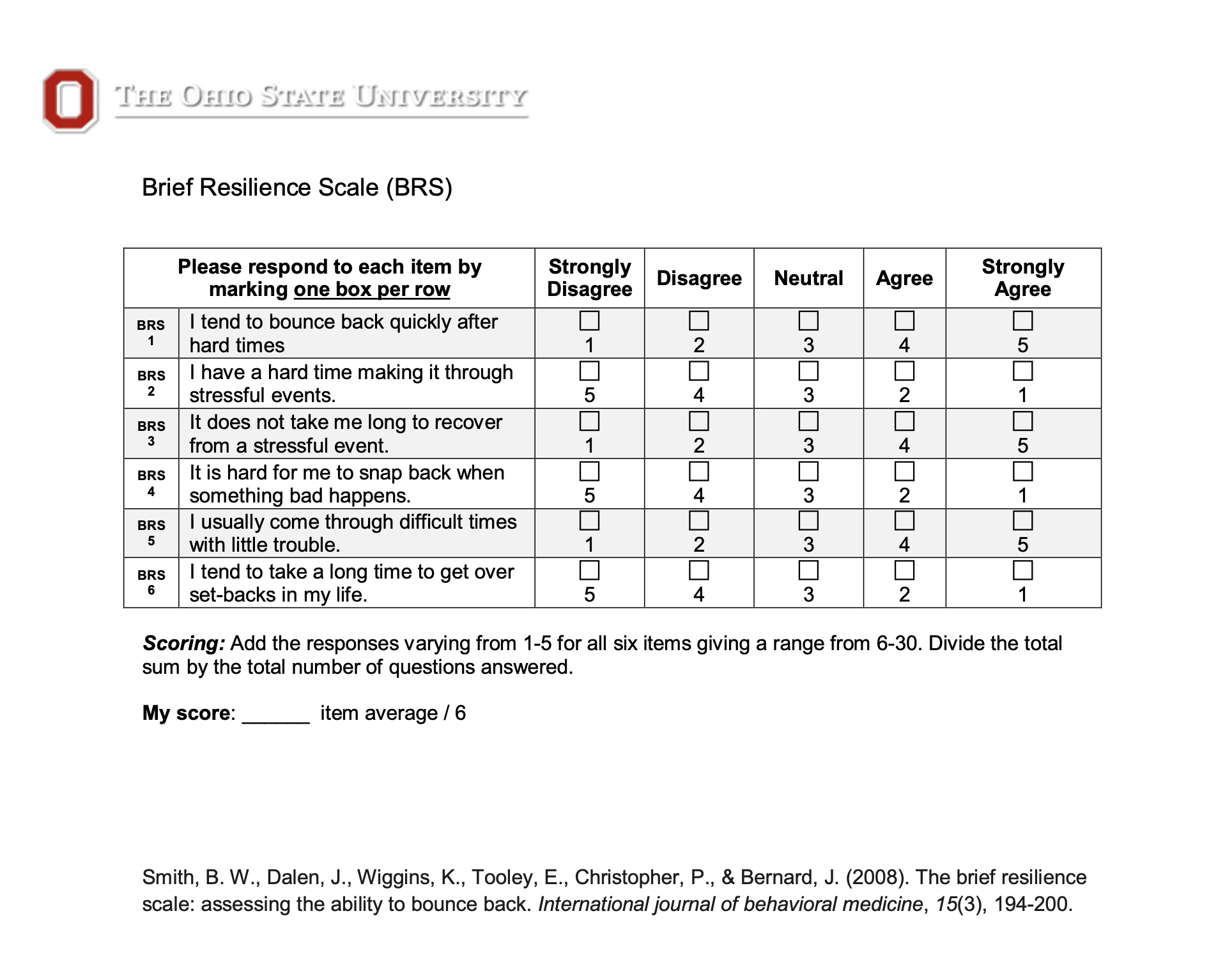
     If you are curious how resilient you are, take the Brief Resilience Assessment (below and attached) to get a pulse on your resiliency.


    To score yourself, add the responses varying from 1-5 for all six questions giving a range from 6-30. Divide the total sum by the 6 to get your average resiliency score. If you scored close to 5, great – you view yourself as resilient and have some positive experiences bouncing back from stressful situations. If you scored below 4, that’s a really valuable data point. Now, what will you do with that information? 


    We know from the science of neuroplasticity that we can change our brains and how we respond to stress. We can all stand to up our game with resiliency, and what better time than now to work on this life skill? And I’ll bet there is someone in your family or at work who is really struggling with this. I’ll share some resiliency techniques and ideas in the next email. And my Wednesday office hours are open to anyone: 10-11am MT. I just ask that you register ahead of time. Have a great day!

  • Up Your Game With GRIT

    Happy Monday. Last week I touched on the importance of resilience as a SKILL – something you can get better at it. To summarize, the 3 parts of resilience you can proactively improve are 1) preparing for, 2) bouncing back after, and 3) adapting in the face of stress.  

    On a related note, this weekend I was supposed to be back on the Penn campus for my 25th reunion. Instead, I participated in an online reunion of sorts. The highlight was a talk and Q&A session with Angela Duckworth, an author and professor of psychology at Penn, who shared her thoughts on GRIT and how it relates to resilience.


    One key takeaway from Angela that I completely agree with => UP YOUR GAME RIGHT NOW. Focus on what you can control, do it to the best of your ability, and strive for more. If you are looking for a job and normally reach out to 4 people a day, double that to 8 people. If you are unmotivated about a work project, set an earlier deadline for yourself than you normally would have and push yourself to focus and get it done. Be a role model for your team and family.

    Angela also quoted Kobe Bryant and asked us to “look for the loose ball” – where in your world might there be an opportunity? For work sure, but also to help, connect, serve. Be right there, don’t lose hope, keep going.


    If you could benefit from coaching or a quick conversation about any of the above, sign up for my Wednesday 10am MT office hours here. Free to my community as I way I can serve.

  • How To Make Better Decisions Right Now

    Happy Friday. Hard to believe my younger son turns 12 today…time and mother nature just keep on going no matter what, don’t they?


    Are you having a harder time making decisions right now? Deciding when to go back to the office, when to venture out, what’s the appropriate next step in your career for you, even small decisions like what to have for dinner?


    First of all, know that this is normal when your mental load is high. Even if you don’t think you are all that worried or too distracted by what’s going on in our external environment right now, there is so much happening in your brain and body that is beyond your conscious awareness that could be causing brain fog, slower response times, stress, etc. Scientists now believe only 5% of human processing happens at the conscious thinking level, like the exposed tip of the iceberg. A whopping 95% is happening at the subconscious level, out of our control, like the bulk of the iceberg under water.


    Knowing your thinking mind is only a small part of the picture, here’s my quick guide to making decisions right now:


    1. SELF-COMPASSION: don’t judge yourself for having a harder time making a decision right now. We all are experiencing this to some extent. Having compassion will calm your nervous system allowing clearer thinking.


    1. MINDSET: think about RESPONDING mindfully versus jumping to a decision from a place of reactivity, fear, and ego. A quote from Viktor Frankle comes to mind: “Between a stimulus and response there is a space. In that space is our power to choose our response. In our response lies our growth and our freedom.”  Remember, at the end of the day, you don’t HAVE to do anything. You have a choice. Perceiving that mental space decreases the pressure and lowers cortisol levels allowing a calmer, more thoughtful decision making process.


    1. RESEARCH: what information can you gather about the topic? Who has been through something similar and what did they do? Even with so much out of our control and unknown, there is quantitative, qualitative and experiential data that will be helpful to you.


    1. SUPPORT: old patterns and habits are well wired into our brains. Making real change is disruptive to the system and we as humans need SUPPORT. Where in your life can you get some support? Ideas: spouse, books, guided meditation, friend, journal, coach, online class. No one wants to feel alone; we evolved in tribes and small communities for support. Even today, and even if you are an introvert, support provides new perspectives and reflection, key parts of effective decision-making.


    If you need resources, drop me an email or text, or come to my free weekly office hours every Wednesday from 10-11am MT. Register here.


    Have an amazing weekend.

  • Do You Have The Skills Needed To Succeed As A Leader?

    Yesterday I touched on the importance of resilience as a critical skill to show up as your best self, no matter what you do, especially now. It will allow you to show up as the best mom or dad, leader, employee, balloon-maker (I knew one believe it or not)…whatever you want to do or be. 

    And it’s not a “one and done” situation. Like your car, you will run better with regular maintenance. My general formula is that your resilience efforts (RE) need to = the level of stressors (S) in your world. [RE=S]


    In addition to resilience, there are 4 other skills that I see as critical in the future workplace. With leaner workforces and a smaller physical office footprint, I predict we are going to see a shifting of power down the official organizational structure to the Team Leader role (anyone who is managing another person). But these Team Leaders, need NEW SKILLS that I’m betting were not included in their on-boarding material:

    1. EMOTIONAL REGULATION: you cannot lead effectively if you are in fight or flight mode.

    2. PSYCHOLOGICAL SAFETY: if employees don’t feel safe, they are not going to be able to bring their best selves to work.

    3. ABILITY TO INSPIRE: micromanaging will not work in the new workplace, so Team Leaders need to be skilled up in how to inspire team members, including messaging.

    4. EMPOWERMENT: leaders who empower their employees at the lowest levels with decision-making authority will have teams that are more agile and able to respond quickly.


    It’s an investment for sure to skill up Team Leaders in these 4 areas, but a relatively small one when you consider the positive ripple effects across the organization.


    If you or someone on your team needs help with these skills, please reach out. My partners and I are here to help.

  • Resilience Needed Now And In The Future

    Happy hump day. How are you doing this week? I hope you are checking in with yourself and engaging in some self-care to keep your batteries charged. 

    Yesterday I participated in a lively virtual panel hosted by BT discussing the future of the workplace. While we had divergent opinions on some topics, like AI in the workplace, one skill we ALL agreed is critical now and moving forward at work is RESILIENCY.


    The definition of resiliency I find the most helpful is that resiliency is the capacity to prepare for, bounce back after, and adapt in the face of stress.


    Because right now it’s Covid-19…and in the future it will be something else…and isn’t it true that it doesn’t really matter what the stressor itself is but HOW YOU RESPOND TO THE STRESS THAT REALLY MATTERS?


    Companies that have resilient employees will come out ahead because they’ll have a workforce comprised of employees that are able to show up as their best selves…you know that version of yourself that is full of creativity, energized, mindful, prepared, ready to take on a challenge. 


    If any of you like to geek on the science behind a concept like resilience like I do OR are looking for techniques to boost your resilience, I’m attaching an article that dives into both the science and the practical side of resilience.


    If you want to chat, I’m offering free career office hours every Wednesday at 10am to my community, where you can ask me about any aspect of your career or job search. Register here for office hours.

  • #1 Tip To Keep Team Members Engaged

    Woohoo – it’s Friday! You made it another week! Hope you had a great week. Do yourself a favor, and please pause your busy day for a moment and reflect on what went well this week, what did you learn, what was the major struggle for you this week and how might you deal with it more effectively in the future. If it helps, email me what you came up with. There is great power in reflection and sharing…and it often goes untapped.


    Ok back to our regularly scheduled show…this week’s focus is on strengths.


    How can managers keep their employees engaged, especially right now with so much uncertainty in business, our health, our economy, our world? This is the time for leaders to step up their game, be human-centered, show vulnerability, express authenticity, and care about their team members. My suggestion for how to do this? It’s simple. Have regular, authentic one-on-one conversations with your team members.


    YUP, SCHEDULE A WEEKLY 1:1 CHECK-IN WITH EACH TEAM MEMBER AND SPEND THE TIME FOCUSING ON HIS OR HER EXPERIENCE.


    This check-in is not the time to get a project update or assign tasks or talk about other transactional items. Sure, those things have to happen as well, but schedule a separate meeting to talk about that. The purpose of the 1:1 check-in is to connect on what is happening in the team member’s world.


    Your role is to listen…pay attention…be curious. Focus on the employee’s experience during the conversation, not your interpretation of their experience. And the conversation doesn’t have to be lengthy: 10-15 minutes is usually enough.


    Here are a few suggested conversation prompts:

    • Did you have a chance to use to use your strengths this week? How might you use your strengths more next week?

    • What did you loathe this past week? How might you do those tasks differently?

    • Do you feel like you added outstanding value this week?

    • What are your priorities for the upcoming week? Any obstacles in your way that we can talk through?


    This may feel awkward at first, but stick with it. Like with a new workout, you build your muscles and it gets easier. Your employees need you to be on your A-game right now. The workplace is changing. You cannot lead effectively in the same way you always have; you need to upgrade your skills, your relationships, and your emotional intelligence to remain effective.


    I’ll be sharing more about this human-centered approach to the workplace on a panel for BT next week, along with a technologist, and a psychological technologist (who knew that was a discipline!?). Should be an interesting conversation so hope you can join. (Link below)


    Panel Topic: The Rapidly Evolving Future of Work

    Date & Time: 5/12, 10-10:45am MT

    Link to register


    Have a great weekend everyone!