Category: Time Management

  • 3D’s for loving life, including work

    Lately, my clients have been lamenting about all the things they do not like about their jobs. Newsflash – no one likes every task required for their role. When we dig into what percentage of their day is filled with tasks they loathe, there’s a magic number I’m looking for. If we determine over 50% of their week is filled with tasks they dread, that’s a big red flag for me. That employee is on track to be disengaged and start looking for a new job.

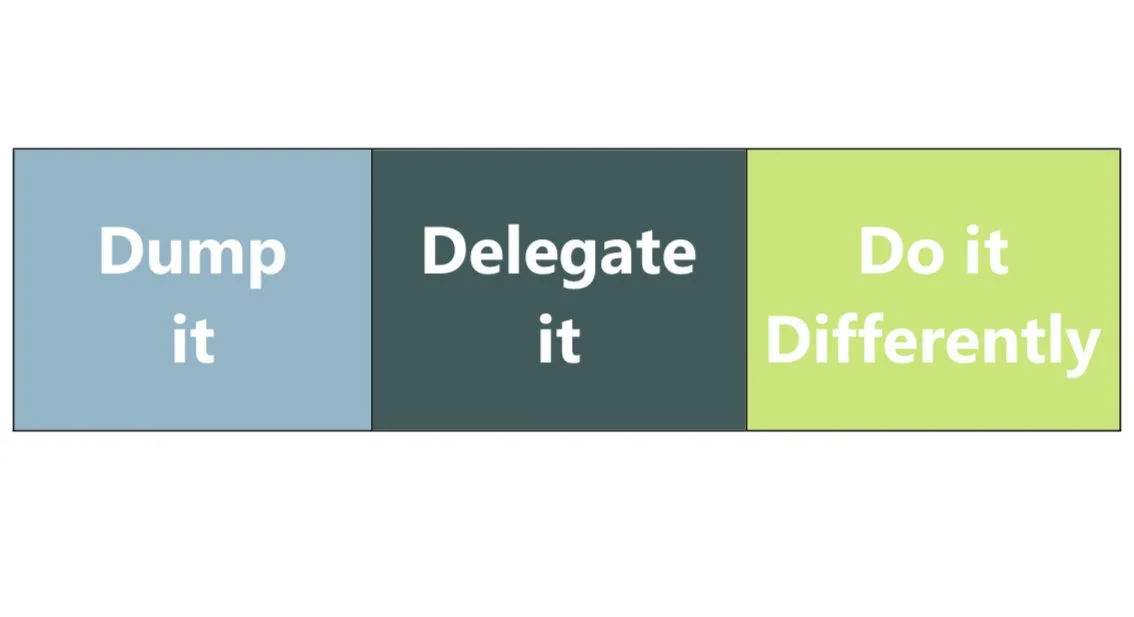
    The 3D framework below will provide you with a cheat sheet for what to do with tasks you dislike.

    #1: DUMP IT: Can you eliminate the task? What will be the repercussions? Will anyone even notice? One client stopped scheduling an unproductive meeting, and no one questioned her.  Another client decreased her attendance at a recurring meeting by 50% and the only consequence was that her mood and productivity improved.

    #2: DELEGATE IT: Might someone else be the better person to do the task? Or perhaps just getting help from someone for a part of the task would help it seem less dreadful. With today’s apps, platforms, and AI, you may also be able to delegate some tasks to technology. Outsourcing to a virtual contractor can be another efficient and cost-effective option for tasks you loathe. 

    #3: DO IT DIFFERENTLY: How might you enjoy the task more? Can you leverage a strength of yours? How might you need to rethink your role to include these tasks? A manager I was coaching, just wanted to get his “work” done, and not deal with the people-side of managing a team. Expanding his idea of a manager’s responsibilities, that his main function was to enable his team to succeed by helping each team member with obstacles, planning, or whatever else was needed, was the “aha” moment he needed to look at those people-tasks differently. Another client “batched” the tasks, setting a regular time when low energy tasks get done; such as on the first Monday of each month, 3 hours will be spent on xyz set of tasks. By doing this, those tasks aren’t hanging over you the rest of the month.

    Take time to notice the tasks that always get pushed to the bottom of your list. These are the tasks to focus on first. To tackle the tasks you put off, think of the 3D’s. Can you DUMP IT, DELEGATE IT, OR DO IT DIFFERENTLY? If so, you may be able to re-engage, focus more on the tasks you enjoy at work and, in turn, find joy once again in your job.

    Click here to download The 3D’s cheat sheet.

    Warmly, 

    Bijal

    The intent of these emails is to provide different perspectives, ideas, and insights as you navigate the path forward for yourself, your team, your organization, and your family.

    Click here if you were forwarded this email and would like to sign up to receive my emails. You may unsubscribe at any time.

    Bijal Choksi, MA, CHPC, ACC

    bijal@huworkteam.com

    Follow HuWork on LinkedIn

  • 8 types of rest this holiday

    When you hear the word REST, you may think of sleep.  And sleep indeed is important and often underappreciated. Here’s hoping we can all catch up on some sleep at the end of 2021. But have you stopped to think of other types of REST you might need, beyond the physical?

    “Rest is much more than sleep or physical relaxation” as noted on Insight Timer’s blog (Insight timer is my favorite free meditation app fyi.) Rest also includes taking a break from things every once in a while, such as from sensory overload (shopping websites, I’m talking to you!), from constantly creating or producing, from our myriad of emotions, and even from other human beings.

    The 7 types of rest included in the blog, and my addition of the 8th:

    1. Physical Rest

    2. Mental Rest

    3. Sensory Rest

    4. Creative Rest

    5. Emotional Rest

    6. Social Rest

    7. Spiritual Rest

    8. Caloric Rest: sometimes our digestive system needs a rest as well. I’m a huge fan of intermittent fasting, for its weight control but also to break up the routine of eating multiple times a day.

    With holiday gatherings in full swing, the type of rest I think I need is social. However, this Thursday would have been my dad’s 76th birthday, so I think I’ll focus on spiritual rest this week, by reconnecting with him spiritually.  

    What about you? What type of rest do you need to focus on right now?

    Warmly, 

    Bijal

    The intent of these emails is to provide different perspectives, ideas, and insights as you navigate the path forward for yourself, your team, your organization, and your family.

    Click here if you were forwarded this email and would like to sign up to receive my emails. You may unsubscribe at any time.

    Bijal Choksi, MA, CHPC, ACC

    bijal@huworkteam.com

    Follow HuWork on LinkedIn

  • Effortless effort

    I recently finished a book called Effortless: Make It Easier to Do What Matters Most by Greg McKeown. While finding the time to read the book did take some effort, taking time to synthesize and use the concepts is taking even more effort!

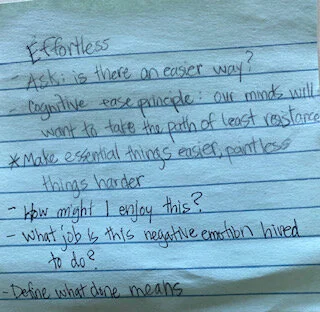
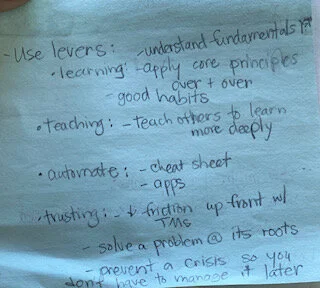
    I tried a low-tech method in response to the question, “How might I make this easier on myself?”, posed by the author. This involved using a lined post-it note to jot down key concepts, and it doubled as my bookmark. It’s not pretty, but you can see in the pictures that I was able to summarize the salient parts of the book on the sticky notes. Afterwards, it took less than a minute to take pictures of those notes and drop them into an Evernote note, for easy reference whenever needed.

    I’m currently testing out the “Automate” lever that’s on the sticky note by creating mini cheat sheets for recurring tasks. Not that I couldn’t remember the steps, but by having this cheat sheet on, you guessed it, a sticky note, it frees my mind up to be ready to make more important decisions and remember more critical information the rest of the day. 

    What is your system to document and apply what you learn from books, podcasts, or classes? I find it challenging at times to move from consumption of the material to the eventual positive impact it can have if put in place.

    Warmly, 

    Bijal

    The intent of these emails is to provide different perspectives, ideas, and insights as you navigate the path forward for yourself, your team, your organization, and your family.

    Click here if you were forwarded this email and would like to sign up to receive my emails. You may unsubscribe at any time.

    Bijal Choksi, MA, CHPC, ACC
    bijal@huworkteam.com

    Follow HuWork on LinkedIn

  • When less is more

    Pablo Picasso said art is the “elimination of the unnecessary.” However, most people will instinctually ADD versus SUBTRACT something. For example, if engagement is waning at work, a manager may increase the number of team meetings. While adding more can be a good thing (feel free to keep bringing home flowers S!)….when facing decision points, I’m starting to consider removing something as an alternative instead.

    I’m currently reading “Subtract” by Leidy Klotz, who makes a nice case for remembering that subtraction can be even more impactful than addition. In fact, I’m now a little obsessed with how life might improve with less: less complexity, less switching gears, less clutter, fewer obligations. Maybe even having fewer Clients, but going deeper with the ones that truly resonate. 

    And if the words “subtract”, “remove”, or “reduce” have a negative connotation to you, you’re not alone. Try substituting “reveal”, “clean”, “carve”, “create”, “construct”, or “streamline” to override a potential sense of loss. 

    If you want to learn more about the science and research behind our drive to add, check out this article.

    Warmly, 

    Bijal

    The intent of these emails is to provide different perspectives, ideas, and insights as you navigate the path forward for yourself, your team, your organization, and your family.

    Click here if you were forwarded this email and would like to sign up to receive my emails. You may unsubscribe at any time.

    Bijal Choksi, MA, CHPC, ACC
    bijal@huworkteam.com

    Follow HuWork on LinkedIn

  • Soph-what?

    My older son is a sophomore in high school, but I had never heard of the term sophrology until recently. The word sophrology comes from the Greek words sos (harmonious and serene), phren (consciousness), and logos (the science of or to study). Essentially, sophrology is the science of consciousness in harmony. In practical terms, sophrology includes some mental and physical exercises, like a guided visualization meditation and gentle movement. 

    Even before the pandemic, 83% of Americans stressed over at least one work-related issue. That equates to 8 out of 10 of your coworkers stressing about work! Layer on the pandemic, and it’s no wonder people are experiencing mental health strains. 

    Below is a 2-3 minute visualization exercise that can change your state of mind dramatically. If you want someone to guide you through a meditation, I teach a free 25-minute guided meditation on the first Wednesday of every month that includes a similar visualization. Sign up here.

    Visualizing Happiness Exercise: 

    1. Close your eyes and think of a place, real or imagined, that brings you happiness.

    2. Visualize the sounds, smells, look, and feel of this place.

    3. Inhale and imagine breathing in calm waves of serenity.

    4. Exhale and allow the good feelings to wash over your body.

    Scheduling in sophrology-type practices can mitigate a stress response, attain the calm needed to respond skillfully to others, and help prevent burnout. BUT you must PLAN to do it. It is experiential, so you must participate in the practices, not just read about them! I suggest putting a recurring appointment on your calendar right now to “RECHARGE”. You won’t be sorry.

    Warmly, 

    Bijal

    The intent of these emails is to provide different perspectives, ideas, and insights as you navigate the path forward for yourself, your team, your organization, and your family.

    Click here if you were forwarded this email and would like to sign up to receive my emails. You may unsubscribe at any time.

    Bijal Choksi, MA, CHPC, ACC

    bijal@huworkteam.com

    Follow HuWork on LinkedIn

  • Overcome weakness with the 3 D’s

    Our culture emphasizes perfection, but everyone has WEAKNESSES. I define weakness as any activity that is draining (e.g., back-to-back zoom calls for some people) or where you don’t feel strong (e.g., networking or public speaking for some people).

    Some of my many weaknesses include: getting distracted by the shiny new project or idea, focusing on the task more than the relationship when facing a deadline, letting go of control, completing the administrative tasks of running a business, and doing the last 10% of a project so it is fully complete.

    Here is my key message on weaknesses: think about how much TIME you are spending on your weaknesses. If it’s more than 50% of your day, then you are probably feeling incredibly drained and not super successful. This week, try incorporating the 3 D’s: 

    1. Dump it

      • Do you really need to do the task? Can you skip the meeting and get an update afterwards? 

    2. Delegate it

      • Can someone else do the task? What’s a weakness for you, may be a strength for someone else.  You may just be helping the career of someone who reports to you by allowing them to take on new tasks. 

    3. Do it differently

      • Is there another way? We all get stuck in our habitual ways of getting work done. Notably, when  shifting from a “doer” role to a leadership role, it’s hard to envision anyone doing it differently than your way.  Instead, try outsourcing, hiring more people, stacking tasks, or even using one of your strengths to get the task done with more joy and perhaps more efficiently.

    It’s okay to admit what you’re not great at – your weaknesses do NOT define who you are. Intentionally doing fewer tasks in your weakness categories can, in fact, help you. So the next time you feel your energy or motivation get zapped at the mere thought of doing a task that is a weakness of yours, try one of the 3 D’s: Dump it, delegate it, do it differently.

    Warmly, 

    Bijal

    The intent of these emails is to provide different perspectives, ideas, and insights as you navigate the path forward for yourself, your team, your organization, and your family.

    Click here if you were forwarded this email and would like to sign up to receive my emails. You may unsubscribe at any time.

    Bijal Choksi, MA, CHPC, ACC

    bijal@huworkteam.com

    Follow HuWork on LinkedIn