Category: Remote / virtual working

  • Power of the employee panel discussion

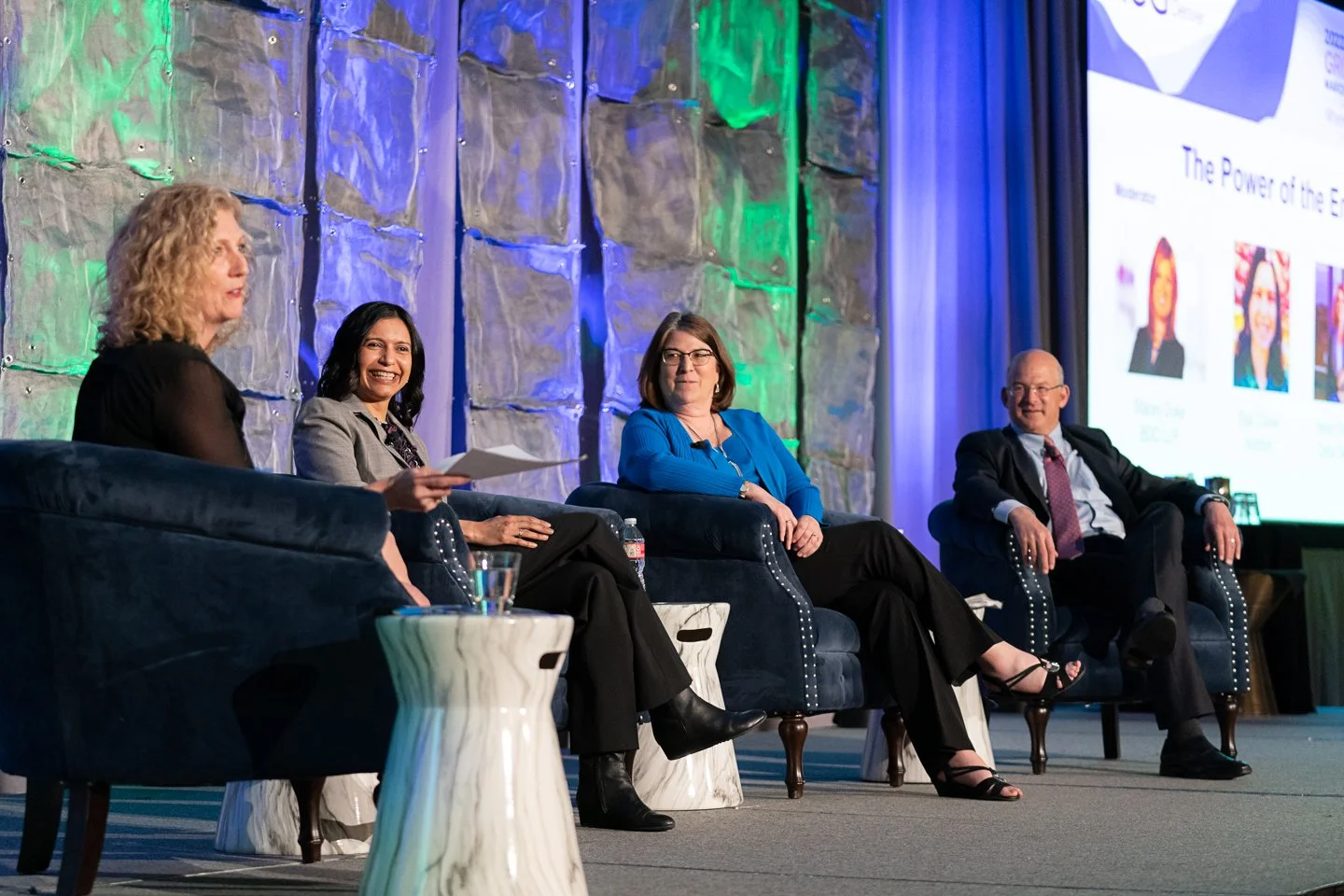
    I was honored to represent #HuWork on a panel discussion centered on the “Power of the Employee”, at the #ACG 2022 Rocky Mountain Corporate Growth Conference.

    Two of the ideas discussed, along with my views about them were: 

    – HOW TO DEAL WITH THE GREAT RESIGNATION? Culture trumps compensation now. Be proactive with “stay” interviews to see what parts of the employee experience need some attention.

    – MANDATE 100% BACK TO THE OFFICE? Only if critical for their role. Shift from thinking about the office as a traditional workplace, to a hub for human connection. Team Leaders need to get employees excited to come back, not force them!

    I would love to hear your take on these topics and what your employer is doing right now.

    Warmly, 

    Bijal

    The intent of these emails is to provide different perspectives, ideas, and insights as you navigate the path forward for yourself, your team, your organization, and your family.

    Click here if you were forwarded this email and would like to sign up to receive my emails. You may unsubscribe at any time.

    Bijal Choksi, MA, CHPC, ACC

    bijal@huworkteam.com

    Follow HuWork on LinkedIn

  • Love your workplace

    One theme I’ve noticed during my years of coaching and consulting is that workplaces are generally not seen as a good thing. If we were giving people’s relationship to work a grade, it would be C+ at best. Who reading this would be happy with a C+? 

    I recently attended a webinar hosted by Harvard Business Review featuring Marcus Buckingham, an expert on workplace happiness and founder of the StandOut strengths assessment. He said something that resonated with my observations: People don’t feel nourished at work.

    That is what has led to “The Great Resignation” in our society, or more accurately, according to Marcus, “THE GREAT REASSESSMENT.” People are asking themselves, “What is work doing for me psychologically?”

    So what can you do about this if you are worried about losing people on your team? Or if you yourself are considering leaving, and want to enjoy work more? In both instances, the work to turn it around really begins with YOU. If you can LOVE at least 20% of your time at work, you will be more engaged. When the number tips below 20%, even slightly, people start to become disengaged. But at least some of this is IN YOUR CONTROL. How can you put a different spin on things or change your mindset so the uninteresting and routine tasks become more interesting and engaging? 

    Additionally, leaders, whether for teams, departments, or companies, need to ask themselves, “Why do we deserve really good employees?” And then use those answers to recalibrate efforts.

    With remote working, alternating days in the office, and virtual meetings becoming the “norm”, it’s a great time to reassess what’s working and not working for you. I challenge you to come up with:

    • Three things you LOVE about your workplace. The view from your office, the difference you are making with clients, the flexibility, etc. 

    • Three things you would like to CHANGE. Shorter commute, fewer interruptions from colleagues, getting out of your cubicle, etc.

    • Three ways you can make your routine tasks more ENGAGING. Meet a colleague for coffee while you each respond to emails, plan walking meetings, set aside a specific time each day/week for the least desirable tasks, etc.

    Warmly, 

    Bijal

    The intent of these emails is to provide different perspectives, ideas, and insights as you navigate the path forward for yourself, your team, your organization, and your family.

    Click here if you were forwarded this email and would like to sign up to receive my emails. You may unsubscribe at any time.

    Bijal Choksi, MA, CHPC, ACC

    bijal@huworkteam.com

    Follow HuWork on LinkedIn

  • Anguishing over languishing

    From the NY Times to a Professor at Wharton, it seems many people are discussing the term “languishing”. Organizational psychologist Adam Grant defines languishing as “a sense of stagnation and emptiness.” Yikes! That’s no fun, but it’s a feeling that many are experiencing with the pandemic lock downs, resulting social isolation, and the ongoing mental toll of it all.

    Even as I type this, I feel a pit in my stomach as this term rings true for me too. Not all day, every day, but certainly with some regularity.

    Here’s my 1-2-3 coping mechanism to deal with my own up and down languishing state:

    1. AWARENESS: becoming aware of what I am feeling is a necessary first step. In other words, “Name it to tame it!” How can I change things if I don’t know what I need to change? 

    2. FOCUS: it may seem counterintuitive, but taking time to focus on that feeling and acknowledge it can help it dissipate. I especially find it helpful to focus on where in the body I feel that emotion. Then, get curious about the feeling – its qualities, texture, motion, and color. What might this physical feeling need at this moment? As Brené Brown says, if you are disembodied from your emotion, it only grows. Finally, implement some actions. For me, this includes leaving my house twice a day, getting out in nature once a day, and finding ways to connect with one of my peeps daily.

    3. REFINE: alas, there is no “one and done” with many feelings, such as languishing. So  I check in weekly, and ask myself “What will help this week?” Knowing it may look different than the week before, is very helpful.

    Can anyone else relate to this languishing feeling? If so, what are your coping mechanisms?

    Warmly, 

    Bijal

    The intent of these emails is to provide different perspectives, ideas, and insights as you navigate the path forward for yourself, your team, your organization, and your family.

    Click here if you were forwarded this email and would like to sign up to receive my emails. You may unsubscribe at any time.

    Bijal Choksi, MA, CHPC, ACC

    bijal@huworkteam.com

    Follow HuWork on LinkedIn

  • How to take the PULSE of a meeting

    Hallelujah! Warm weather has officially arrived in Denver, and I have a bad case of spring fever.  Zoom meetings definitely seemed more appealing when it was cold out. Whether you are attending a meeting online or (gasp!) in-person, do you sometimes feel you are on a different wavelength than the other participants? That maybe you are zigging, while others are zagging? I recently had this happen when I was zeroing in on the details of an upcoming workshop, while my business partner was looking broadly at the overall structure. In short, it got awkward. 

    I wish I had heard of Linda Liang’s PULSE method, to actively read a room when attending a meeting. I’ll be using her PULSE framework to “size up” the room from now on, and encourage you to as well. Don’t let its simplicity fool you. It’s a powerful, quick framework.

    P= What is the PURPOSE of the meeting/event? Is there an agenda? Is it buzzing, somber, joking, nervous?

    U= What is the UNDERLYING APPROACH? Is it focused on the details or the big picture? People or task oriented? 

    L= Is the meeting more LEADER-LED, with one person mainly talking, or TEAM ORIENTED, with people taking turns and equally contributing?

    S= Is the pace of the meeting SLOW OR FAST? 

    E= What are the EMOTIONS of participants? How are people looking and feeling? Are they quiet or talkative? What is the “tone” of the room, and what does it tell you? 

    To be more effective during meetings, aim to mirror the “style” of what is going on. Clearly, I missed the “U”, or “underlying approach”, part of this framework with my business partner. In hindsight, it would have been helpful to discuss expectations for our discussion and make sure we were aligned. I’ve already found Linda’s PULSE framework uber-helpful. Try it out yourself and let me know if it helps you as well.

    Warmly, 

    Bijal

    The intent of these emails is to provide different perspectives, ideas, and insights as you navigate the path forward for yourself, your team, your organization, and your family.

    Click here if you were forwarded this email and would like to sign up to receive my emails. You may unsubscribe at any time.

    Bijal Choksi, MA, CHPC, ACC

    bijal@huworkteam.com

    Follow HuWork on LinkedIn

  • Returning to a new “normal”

    Your organization is probably thinking about returning to the office, using a hybrid approach, or perhaps working from home permanently – all of these bring opportunities to think about new and better ways of working.  

     The 60-30-10 rule for effective teamwork, discovered by researcher J. Richard Hackman, states the following about a team’s success: 

    • 60% depends on prework, or activities before the actual work, 

    • 30%  can be linked to the initial launch (or relaunch) of the team, and

    • Only 10% is dependent on the day-to-day teamwork

    Anytime there is a major change to the team: new location, major project, new team members, I encourage you to hold a brief 60-90 minute launch session with the team. It can even be spread out over two sessions. But it’s critical that every single team member is present.  

    Using the image of a funnel – starting wide, then narrowing down,  include at a minimum in your agenda:

    1. VISION: Everyone must be crystal clear where the team is headed. Discuss where the team fits in with the broader company vision and the team shared goals.

    2. ROLES:  Everyone needs to have a shared understanding of how each person fits in and a frank discussion of potential obstacles.

    3. RESOURCES:  What resources are needed? (information, budget, people, etc.)

    4. NORMS: How will team members interact? What are the communication expectations, such as responses to emails in ”X” hours, process for raising issues, what mistakes are acceptable, what mistakes are unacceptable, etc.

    Use the (re)launch as an opportunity to get people excited, build trust, and bring focus back to the team’s goals.

    For more ideas, please join me on April 23 for Coffee and Conversation: Make Work More Human, to explore what it takes to be a human-centered organization. We’ll talk about behaviors and practices that are going well in your organization, and things that you’d like to see changed. 

    I invite you to take HuWork’s Human Factor Assessment ahead of time to highlight the areas where your company is shining and think about changes to consider putting in place – whether you are working as a people manager, an individual contributor, or influencing change as an HR leader or consultant.

    To join this virtual conversation on Friday, April 23 at 12pm MDT, please click here to register. I will email the Zoom link the day before the event.

    Warmly, 

    Bijal

    The intent of these emails is to provide different perspectives, ideas, and insights as you navigate the path forward for yourself, your team, your organization, and your family.

    Click here if you were forwarded this email and would like to sign up to receive my emails. You may unsubscribe at any time.

    Bijal Choksi, MA, CHPC, ACC

    bijal@huworkteam.com

    Follow HuWork on LinkedIn

  • Letting go of your false identity

    Not to be obvious but one’s IDENTITY is so personal, so UNIQUE to each of us, like our fingerprints. What may NOT be so obvious is that people MAKE CHOICES THAT ALIGN WITH THEIR IDENTITY.

    ALL DAY LONG, YOU ARE CONSCIOUSLY AND UNCONSCIOUSLY MAKING CHOICES THAT ALIGN WITH YOUR IDENTITY.

    What do I mean by that? Let’s say one of your IDENTITIES is being a peacekeeper, for family members, co-workers, friends. Then you likely will not choose behaviors that will provoke people around you. You may hold back your ideas and choices because you may fear how they will land with others. And then that has the unintended consequence of others believing you are a small thinker, when really you have these big bold ideas.

    So if you find yourself making poor choices (ahem food, drink, movement, relationships, career, wealth, mindset), CONSIDER YOUR BELIEFS ABOUT YOUR IDENTITY. Are you of two minds related to that area of your life? E.g., “I want to be healthy” AND “I need the quick hit of satisfaction from my afternoon sugar-filled snack.” Those two ideas don’t really align – they are IN CONFLICT. Which will lead to conflict in your life related to that area of your life. 

    BUT if you can align your identity with the positive outcome you are striving for…VOILA! Now your mind will take that identity as marching orders and align itself up to that GOAL. It doesn’t even matter if it is 100% true yet. For example, with food, it’s less strenuous on your willpower to refuse that brownie if your identity is “I am a healthy eater.”

    To break it down, here are the steps:

    1.     Identify where there are BEHAVIORS in your life you wish to change. “Eat healthier.”

    2.     To resolve that conflict, consider what you want your IDENTITY to be as it relates to that behavior. “I am a healthy eater.”

    3.     Then BUILD YOUR BELIEFS AROUND THAT IDENTITY. Literally state your beliefs to yourself. This will send direct marching orders to your mind. Your mind will receive that INFORMATION like a blueprint and the actions you want will be easier. E.g.,

    –        Food close to nature nourishes my body, mind, and soul.

    –        Big pharma does not care about my health.

    –        Processed food will harm my health.

    –        Simple foods are better for me than overly complicated ones where I don’t know what went into the dish.

    TAKEAWAY: By deliberately crafting your identity and beliefs, you will be less likely to take mindless actions that are not serving you, and more easily choose those that do. Your mind will automatically ALIGN to uphold your IDENTITY and BELIEFS. Try it. It’s POWERFUL.

    Would LOVE to hear about how you might apply the above concept to areas of your life. Drop me a quick note or text. And I’ll continue to keep 3-20 minute slots open on my calendar each week for this community if you want to talk through applying any of the models and concepts I’ve been sharing in these emails.

    Take good care,

    Bijal

    The intent of these emails is to provide different perspectives, ideas, and insights as you navigate the path forward for yourself, your team, your organization, and your family.

    October offer: Buy a package of 6 coaching sessions and receive an additional session + my 5-week online course on finding your unique strengths for free. This is a tremendous offer and is open to individuals and teams.

    Bijal Choksi, MA, CHPC, ACC

    bijal@huworkteam.com

    Let’s chat! Schedule a brainstorming session with me here

    Follow HuWork on LinkedIn