Category: Engagement

  • Atlas of the Heart

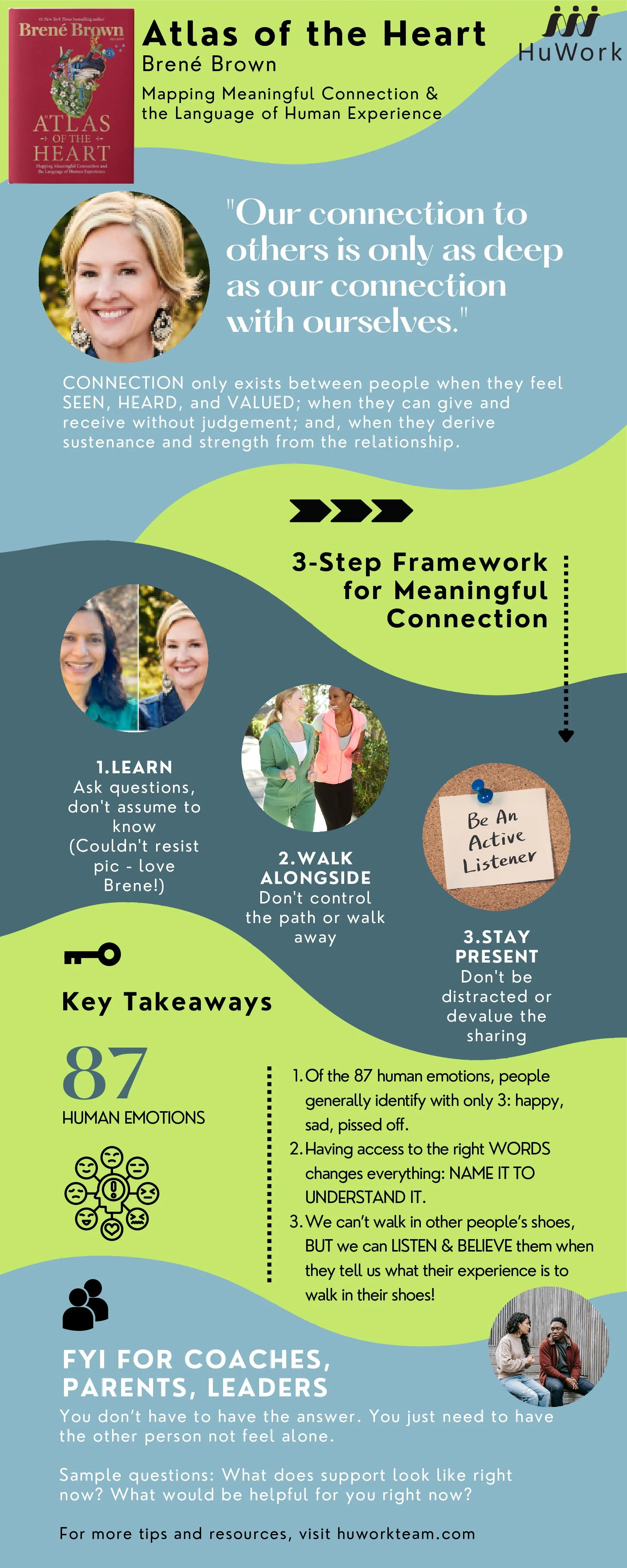
    As a long-time fan of Brené Brown, a down to earth researcher of human connection, I was ecstatic to find the entire season of her new book and show “Atlas of the Heart – Mapping Meaningful Connection” on a long flight. I completely geeked out, taking notes on my laptop, and thinking about how this information might help my clients and community. 

    It is really dense, covering 87 human emotions as well as a framework for connecting with people in your world. Instead of a typical book review, I’m testing out an infographic style summary. Let me know if you like this format! (Plus, I couldn’t resist mocking up a photo of Brené and I side by side, which you’ll see on the infographic.)

    One key takeaway for me from this book/series: don’t control the path for the other person; it’s their journey. But, I am here for support.

    In case you are not familiar with Brené, she shot to fame in the early 2000’s with her research on the power of vulnerability. Here’s her Ted Talk on the topic.

    Warmly, 

    Bijal

    The intent of these emails is to provide different perspectives, ideas, and insights as you navigate the path forward for yourself, your team, your organization, and your family.

    Click here if you were forwarded this email and would like to sign up to receive my emails. You may unsubscribe at any time.

    Bijal Choksi, MA, CHPC, ACC

    bijal@huworkteam.com

    Follow HuWork on LinkedIn
  • How to communicate powerfully

    Communication skills can make or break relationships, whether at work or personal life. Do any of these situations apply to you?

    •  You think you are communicating clearly, but it doesn’t seem others are on the same page.

    • You take the initiative on a project, but then get frustrated when your manager indicates it was wasted effort.

    • Conversations don’t go in the direction you were hoping.

    • You find yourself having the same conversations with certain people without resolution.

    • People often seem defensive or triggered in conversation with you, especially when you are just asking clarifying questions.

    If you identify with any of those situations, come attend a 15-minute Facebook live on 12/19 at 12pm MST with me and Rod Francis, the founder of the Emergent Coach Training program. We will be discussing practical communication skills such as the art of asking powerful questions and active listening skills. We will also share details about a new supportive community for individuals wanting to incorporate coaching skills into their profession, whether they are in a coaching role or not. Tune in here!

    In addition, another colleague, Sherry Trebes, will be going live on Instagram this Thursday, December 15 at 12pm MST on how coaching skills can improve all areas of one’s life. Follow @interactualizer on Instagram for this event. This will be first in a series of quick, live learning events.


    I hope to see you there!

    Warmly, 

    Bijal

    The intent of these emails is to provide different perspectives, ideas, and insights as you navigate the path forward for yourself, your team, your organization, and your family.

    Click here if you were forwarded this email and would like to sign up to receive my emails. You may unsubscribe at any time.

    Bijal Choksi, MA, CHPC, ACC

    bijal@huworkteam.com

    Follow HuWork on LinkedIn

  • Power of the employee panel discussion

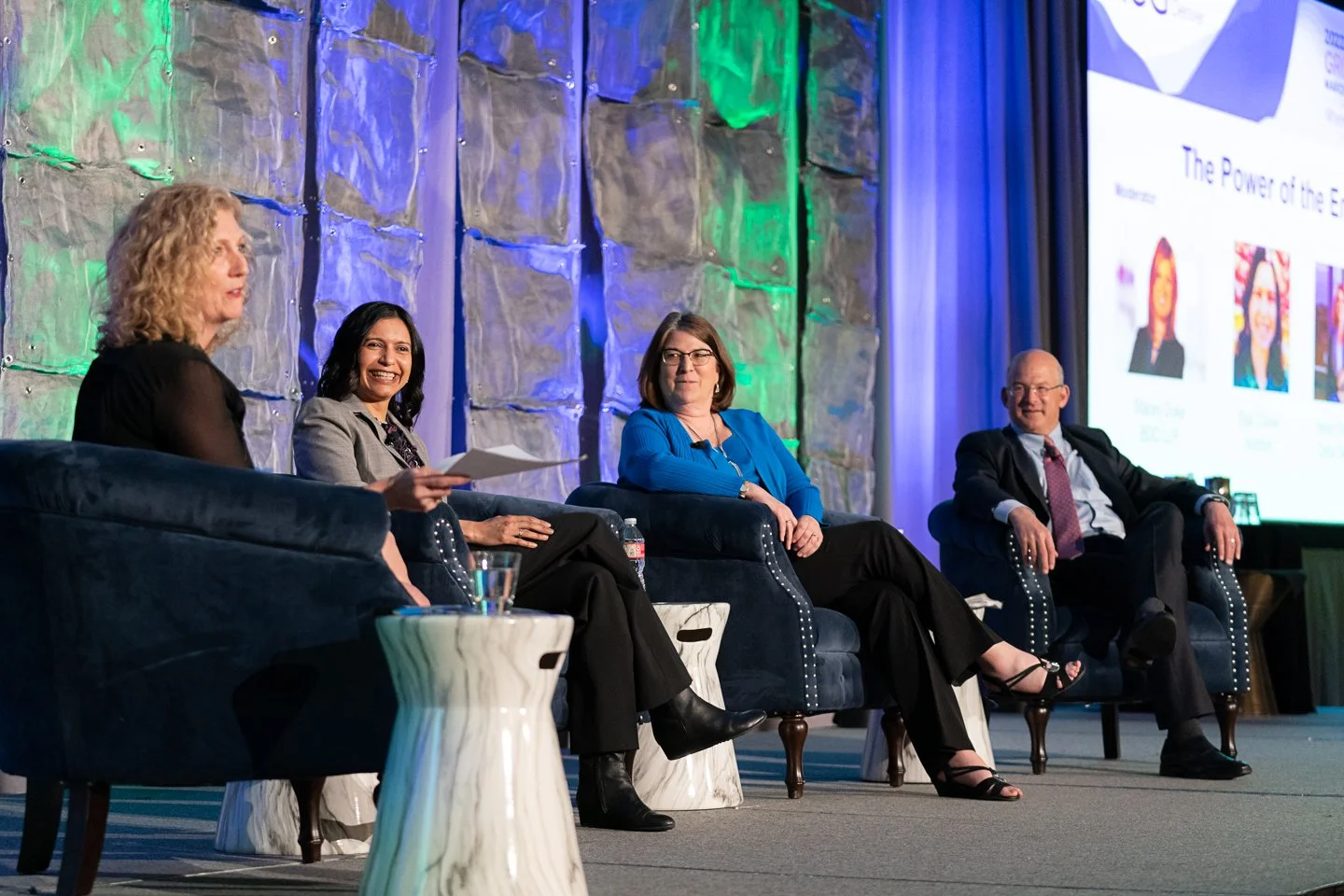
    I was honored to represent #HuWork on a panel discussion centered on the “Power of the Employee”, at the #ACG 2022 Rocky Mountain Corporate Growth Conference.

    Two of the ideas discussed, along with my views about them were: 

    – HOW TO DEAL WITH THE GREAT RESIGNATION? Culture trumps compensation now. Be proactive with “stay” interviews to see what parts of the employee experience need some attention.

    – MANDATE 100% BACK TO THE OFFICE? Only if critical for their role. Shift from thinking about the office as a traditional workplace, to a hub for human connection. Team Leaders need to get employees excited to come back, not force them!

    I would love to hear your take on these topics and what your employer is doing right now.

    Warmly, 

    Bijal

    The intent of these emails is to provide different perspectives, ideas, and insights as you navigate the path forward for yourself, your team, your organization, and your family.

    Click here if you were forwarded this email and would like to sign up to receive my emails. You may unsubscribe at any time.

    Bijal Choksi, MA, CHPC, ACC

    bijal@huworkteam.com

    Follow HuWork on LinkedIn
  • 3D’s for loving life, including work

    Lately, my clients have been lamenting about all the things they do not like about their jobs. Newsflash – no one likes every task required for their role. When we dig into what percentage of their day is filled with tasks they loathe, there’s a magic number I’m looking for. If we determine over 50% of their week is filled with tasks they dread, that’s a big red flag for me. That employee is on track to be disengaged and start looking for a new job.

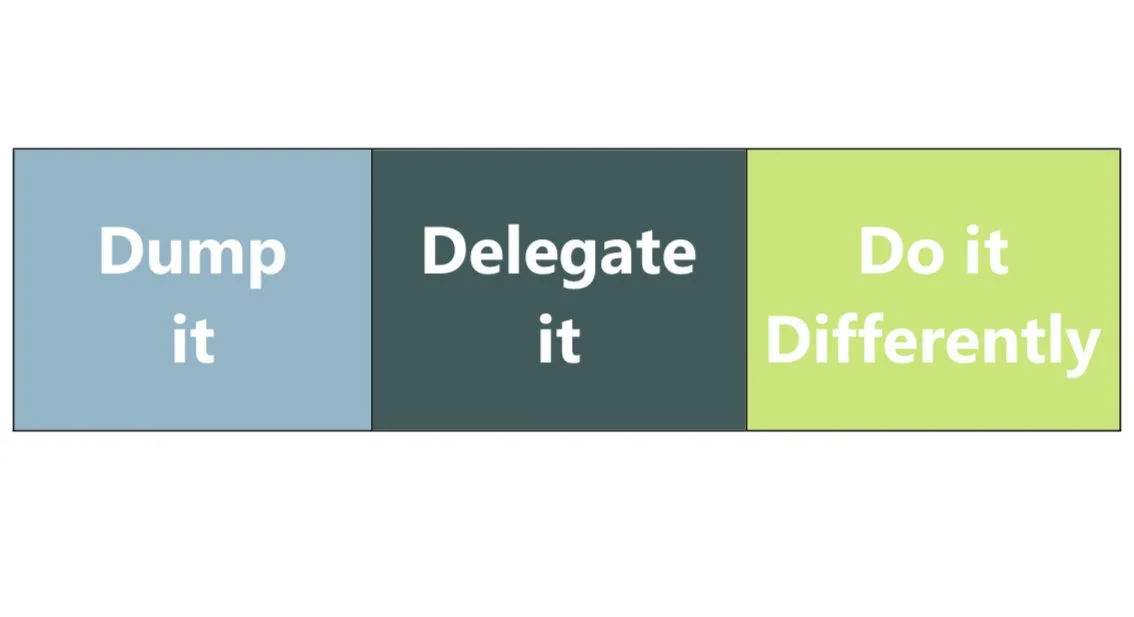
    The 3D framework below will provide you with a cheat sheet for what to do with tasks you dislike.

    #1: DUMP IT: Can you eliminate the task? What will be the repercussions? Will anyone even notice? One client stopped scheduling an unproductive meeting, and no one questioned her.  Another client decreased her attendance at a recurring meeting by 50% and the only consequence was that her mood and productivity improved.

    #2: DELEGATE IT: Might someone else be the better person to do the task? Or perhaps just getting help from someone for a part of the task would help it seem less dreadful. With today’s apps, platforms, and AI, you may also be able to delegate some tasks to technology. Outsourcing to a virtual contractor can be another efficient and cost-effective option for tasks you loathe. 

    #3: DO IT DIFFERENTLY: How might you enjoy the task more? Can you leverage a strength of yours? How might you need to rethink your role to include these tasks? A manager I was coaching, just wanted to get his “work” done, and not deal with the people-side of managing a team. Expanding his idea of a manager’s responsibilities, that his main function was to enable his team to succeed by helping each team member with obstacles, planning, or whatever else was needed, was the “aha” moment he needed to look at those people-tasks differently. Another client “batched” the tasks, setting a regular time when low energy tasks get done; such as on the first Monday of each month, 3 hours will be spent on xyz set of tasks. By doing this, those tasks aren’t hanging over you the rest of the month.

    Take time to notice the tasks that always get pushed to the bottom of your list. These are the tasks to focus on first. To tackle the tasks you put off, think of the 3D’s. Can you DUMP IT, DELEGATE IT, OR DO IT DIFFERENTLY? If so, you may be able to re-engage, focus more on the tasks you enjoy at work and, in turn, find joy once again in your job.

    Click here to download The 3D’s cheat sheet.

    Warmly, 

    Bijal

    The intent of these emails is to provide different perspectives, ideas, and insights as you navigate the path forward for yourself, your team, your organization, and your family.

    Click here if you were forwarded this email and would like to sign up to receive my emails. You may unsubscribe at any time.

    Bijal Choksi, MA, CHPC, ACC

    bijal@huworkteam.com

    Follow HuWork on LinkedIn
  • Love your workplace

    One theme I’ve noticed during my years of coaching and consulting is that workplaces are generally not seen as a good thing. If we were giving people’s relationship to work a grade, it would be C+ at best. Who reading this would be happy with a C+? 

    I recently attended a webinar hosted by Harvard Business Review featuring Marcus Buckingham, an expert on workplace happiness and founder of the StandOut strengths assessment. He said something that resonated with my observations: People don’t feel nourished at work.

    That is what has led to “The Great Resignation” in our society, or more accurately, according to Marcus, “THE GREAT REASSESSMENT.” People are asking themselves, “What is work doing for me psychologically?”

    So what can you do about this if you are worried about losing people on your team? Or if you yourself are considering leaving, and want to enjoy work more? In both instances, the work to turn it around really begins with YOU. If you can LOVE at least 20% of your time at work, you will be more engaged. When the number tips below 20%, even slightly, people start to become disengaged. But at least some of this is IN YOUR CONTROL. How can you put a different spin on things or change your mindset so the uninteresting and routine tasks become more interesting and engaging? 

    Additionally, leaders, whether for teams, departments, or companies, need to ask themselves, “Why do we deserve really good employees?” And then use those answers to recalibrate efforts.

    With remote working, alternating days in the office, and virtual meetings becoming the “norm”, it’s a great time to reassess what’s working and not working for you. I challenge you to come up with:

    • Three things you LOVE about your workplace. The view from your office, the difference you are making with clients, the flexibility, etc. 

    • Three things you would like to CHANGE. Shorter commute, fewer interruptions from colleagues, getting out of your cubicle, etc.

    • Three ways you can make your routine tasks more ENGAGING. Meet a colleague for coffee while you each respond to emails, plan walking meetings, set aside a specific time each day/week for the least desirable tasks, etc.

    Warmly, 

    Bijal

    The intent of these emails is to provide different perspectives, ideas, and insights as you navigate the path forward for yourself, your team, your organization, and your family.

    Click here if you were forwarded this email and would like to sign up to receive my emails. You may unsubscribe at any time.

    Bijal Choksi, MA, CHPC, ACC

    bijal@huworkteam.com

    Follow HuWork on LinkedIn

  • Happy New Year! Wishing you the very best in 2022

    After navigating ourselves, our families, and our clients through another year of a global pandemic and a variety of other challenges, we at HuWork are more motivated than ever about our mission to help talented people improve their results and their happiness, and to help organizations be the place those people want to work.  

    While it’s been a tough year on many levels, one recent challenge I faced was an unwanted Christmas present my older son and I received – omicron. Thankfully, I only experienced mild symptoms. I hope Santa, the universe, or whatever else you believe in brought you a better present!

    I was fortunate to be in Miami at the time, recuperating in warm weather near the ocean, but my husband was in Colorado. This was the first time since 1996 that I was not able to ring in the New Year, nor celebrate his birthday (he’s a new year’s baby) with him. A few things I reminded myself to be grateful for when I was feeling down about this separation were:

    • Time with my high school junior before he flies the coop: binge watching shows, researching colleges, planning meals

    • Time without obligations: meditating, journaling, just sitting and staring at the ocean, solo walks on the beach

    • Time to reflect on the year. Three questions I’m reflecting on are:

      • What are 3 moments that you LOVED in 2021?

      • What are 3 LESSONS you learned in 2021?

      • What BEAUTY in your life are you overlooking that you can appreciate in 2022?

    In addition, a book that helped my mindset was “Fierce Self-Compassion” by Kristin Neff. I highly recommend it.

    For anyone working with a team, another resource I recommend is our The Human FactorTM, an assessment we designed to help employees at all levels consider how human is my workplace? It is based on our experience and research showing that a workplace where mindsets, behaviors and policies that support people flourishing will have better business results and a positive impact on the world. You can use this assessment to spark new thinking and start meaningful conversations with your team. Or click here and we would be happy to set up time to chat about your results.

    The entire HuWork team wants to help our fellow humans navigate personal and professional challenges in 2022 and beyond. What questions are you reflecting on?  What challenges will you face in the New Year?

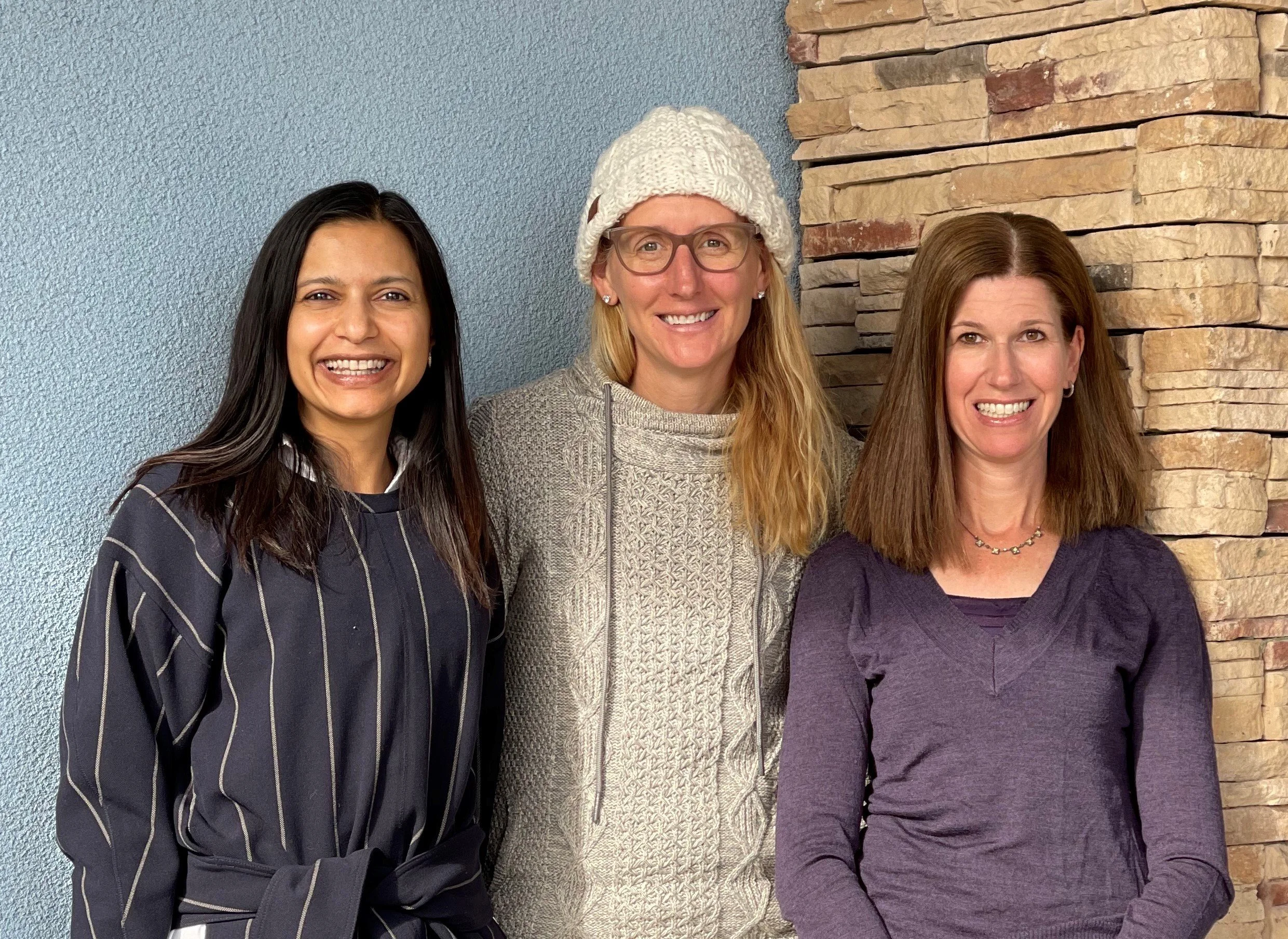
    ​​Here is a picture of me with my business partners, Liesa Wierschke Taylor and Bonnie Davis. So grateful for you both!

    Warmly, 

    Bijal

    The intent of these emails is to provide different perspectives, ideas, and insights as you navigate the path forward for yourself, your team, your organization, and your family.

    Click here if you were forwarded this email and would like to sign up to receive my emails. You may unsubscribe at any time.

    Bijal Choksi, MA, CHPC, ACC

    bijal@huworkteam.com

    Follow HuWork on LinkedIn
  • #TeamCulture

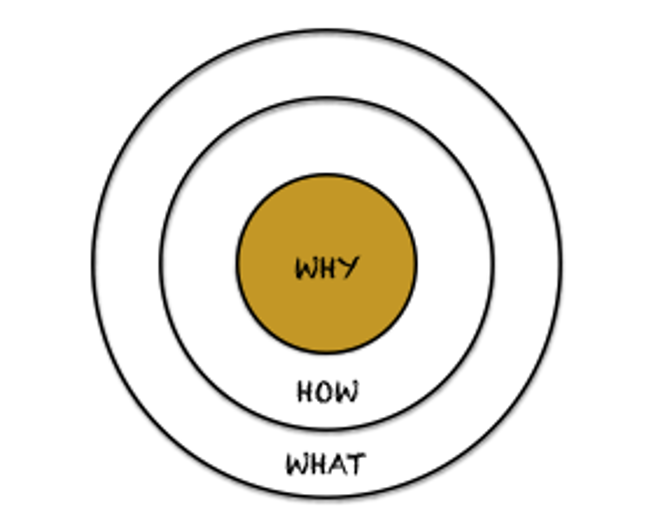
    I recently facilitated my first in-person workshop after nearly 18 months of virtual “zoomsites” and workshops. Yeehaw! (We were in Nashville.) The main theme for the leadership team was RECONNECTING with each other, but the team also wanted to RESET how they work together. To accomplish this,  we leveraged Simon Sinek’s Golden Circle concept, with the team “WHY” in the middle, followed by the “WHAT” and the “HOW”. 

    The team came up with an inspirational WHY, or purpose statement, that the rest of the department could rally around and feel proud of. Sample WHY statements include: “We accelerate the growth of our people to their full potential.” “We innovate and disrupt the status quo to bring efficiency and humanity to our customers.”

    The WHAT centered around determining 2022 priorities. But a distinguishing factor we considered was what priorities live up to the WHY statement. 

    The HOW is about the team culture, how they show up. We began by taking a real-time assessment of team dynamics using an anonymous online survey, and identified a big gap for trust and collaboration. This led to a vulnerable conversation about what steps the leadership team members could take to improve trust and collaboration. HOW do they need to show up? I asked them to come up with 5-10 hashtags that succinctly summarize their most important operating principles and values. One of them was #WeAreBetterTogether. 

    I have found that companies put so much focus on the WHAT – the projects and tasks. But not enough on the HOW – the values and culture. If you were going to craft a hashtag describing your ideal team culture, what would it be?

    Warmly, 

    Bijal

    The intent of these emails is to provide different perspectives, ideas, and insights as you navigate the path forward for yourself, your team, your organization, and your family.

    Click here if you were forwarded this email and would like to sign up to receive my emails. You may unsubscribe at any time.

    Bijal Choksi, MA, CHPC, ACC

    bijal@huworkteam.com

    Follow HuWork on LinkedIn
  • Exploring other career options?

    According to recent statistics, 70% of the workforce is actively looking for a job change. That’s a HUGE number!

    For managers, luckily before an employee starts an active job search, there are subtle signs of disengagement:

    • Change in attitude – negativity, critical of the team/company/position

    • Change in activity – reduced productivity, different work habits

    • Breakdown in communication and/or relationships

    • Apparent complacency, lack of enthusiasm, waning commitment, withdrawn 

    If you are a leader and are beginning to notice any of these behaviors, don’t delay! Have a conversation with your employee immediately. Share some of the behaviors you have noticed and inquire as to  “what’s up?” You may also ask if they feel they are adding value, what do they need at work, what are their growth plans?

    On the flipside, if you are the person exploring other career options, I’m speaking on a career panel Tuesday, November 16 to support women who are in a job search, contemplating a career change, or feeling burnout from work/family demands of the past 18 months. You can learn more and sign up here.

    Warmly, 

    Bijal

    The intent of these emails is to provide different perspectives, ideas, and insights as you navigate the path forward for yourself, your team, your organization, and your family.

    Click here if you were forwarded this email and would like to sign up to receive my emails. You may unsubscribe at any time.

    Bijal Choksi, MA, CHPC, ACC

    bijal@huworkteam.com

    Follow HuWork on LinkedIn

  • Effortless effort

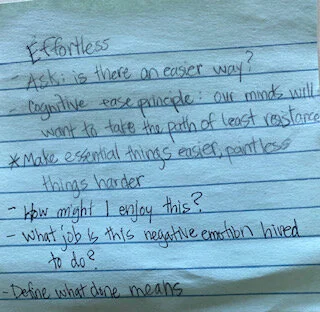
    I recently finished a book called Effortless: Make It Easier to Do What Matters Most by Greg McKeown. While finding the time to read the book did take some effort, taking time to synthesize and use the concepts is taking even more effort!

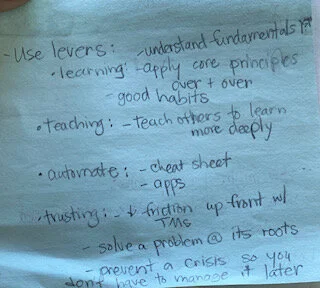
    I tried a low-tech method in response to the question, “How might I make this easier on myself?”, posed by the author. This involved using a lined post-it note to jot down key concepts, and it doubled as my bookmark. It’s not pretty, but you can see in the pictures that I was able to summarize the salient parts of the book on the sticky notes. Afterwards, it took less than a minute to take pictures of those notes and drop them into an Evernote note, for easy reference whenever needed.

    I’m currently testing out the “Automate” lever that’s on the sticky note by creating mini cheat sheets for recurring tasks. Not that I couldn’t remember the steps, but by having this cheat sheet on, you guessed it, a sticky note, it frees my mind up to be ready to make more important decisions and remember more critical information the rest of the day. 

    What is your system to document and apply what you learn from books, podcasts, or classes? I find it challenging at times to move from consumption of the material to the eventual positive impact it can have if put in place.

    Warmly, 

    Bijal

    The intent of these emails is to provide different perspectives, ideas, and insights as you navigate the path forward for yourself, your team, your organization, and your family.

    Click here if you were forwarded this email and would like to sign up to receive my emails. You may unsubscribe at any time.

    Bijal Choksi, MA, CHPC, ACC

    bijal@huworkteam.com

    Follow HuWork on LinkedIn

  • Emotional Valence

    Many of you know I grew up in New York, so the 20 year anniversary of 9/11 (how can it have been 20 years already?) is still a weight I’m carrying around, as well as a shadow over my feelings about NY. 

    This emotional charge of being drawn to or away from something is known in psychology as EMOTIONAL VALENCE. It’s referring to the intrinsic attractiveness (Positive Valence) or aversiveness (Negative Valence) of events, people, things, or situations. 

    (For my fellow science nerds, valence is a chemistry term describing the bonding of atoms; positive, if its own electrons are used in forming the bond, or negative, if another atom’s electrons are used. For example, a carbon atom can share four of its electrons with other atoms and therefore has a valence of +4.)

    On a lighter note, seeing the #1 ranked men’s tennis player, Novak Djokovic, lose his temper and smash his tennis racket on the ground at the US Open Finals on Sunday changed my emotional valence towards him (not that he cares what I think!) To counteract a negative emotional valence towards someone you may actually interact with, here is what I try to do:

    • Ground myself: even 30 seconds alone to breathe and get centered often changes the interaction, and makes me less reactive.

    • Lower my expectations: this has led to less disappointment when the other person has a pattern that hasn’t met previous expectations. 

    • Internally recognize something positive about the person or situation: our minds can have a tendency to fixate on what is wrong, so counteract with something like, “He is always on time for meetings.”

    • Verbalize something I genuinely appreciate about the other person: Such as, “I love how you are able to say what’s on your mind regardless of who’s in the room.”

    When relating to a situation or experience beyond your control, the key to shifting your emotional valence is to focus on the positive. What techniques do you use to reframe negative feelings?

    Warmly, 

    Bijal

    The intent of these emails is to provide different perspectives, ideas, and insights as you navigate the path forward for yourself, your team, your organization, and your family.

    Click here if you were forwarded this email and would like to sign up to receive my emails. You may unsubscribe at any time.

    Bijal Choksi, MA, CHPC, ACC

    bijal@huworkteam.com

    Follow HuWork on LinkedIn