Category: Conflict Management

  • Atlas of the Heart

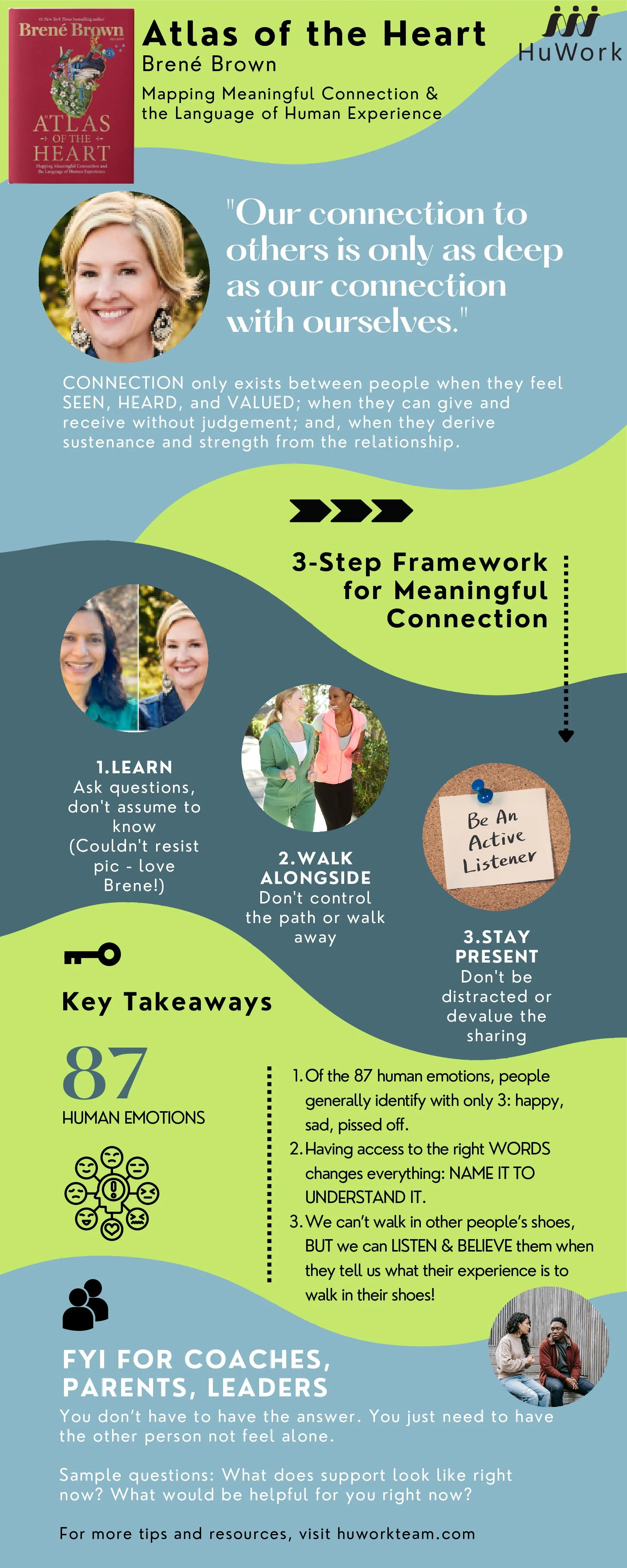
    As a long-time fan of Brené Brown, a down to earth researcher of human connection, I was ecstatic to find the entire season of her new book and show “Atlas of the Heart – Mapping Meaningful Connection” on a long flight. I completely geeked out, taking notes on my laptop, and thinking about how this information might help my clients and community. 

    It is really dense, covering 87 human emotions as well as a framework for connecting with people in your world. Instead of a typical book review, I’m testing out an infographic style summary. Let me know if you like this format! (Plus, I couldn’t resist mocking up a photo of Brené and I side by side, which you’ll see on the infographic.)

    One key takeaway for me from this book/series: don’t control the path for the other person; it’s their journey. But, I am here for support.

    In case you are not familiar with Brené, she shot to fame in the early 2000’s with her research on the power of vulnerability. Here’s her Ted Talk on the topic.

    Warmly, 

    Bijal

    The intent of these emails is to provide different perspectives, ideas, and insights as you navigate the path forward for yourself, your team, your organization, and your family.

    Click here if you were forwarded this email and would like to sign up to receive my emails. You may unsubscribe at any time.

    Bijal Choksi, MA, CHPC, ACC

    bijal@huworkteam.com

    Follow HuWork on LinkedIn

  • How to communicate powerfully

    Communication skills can make or break relationships, whether at work or personal life. Do any of these situations apply to you?

    •  You think you are communicating clearly, but it doesn’t seem others are on the same page.

    • You take the initiative on a project, but then get frustrated when your manager indicates it was wasted effort.

    • Conversations don’t go in the direction you were hoping.

    • You find yourself having the same conversations with certain people without resolution.

    • People often seem defensive or triggered in conversation with you, especially when you are just asking clarifying questions.

    If you identify with any of those situations, come attend a 15-minute Facebook live on 12/19 at 12pm MST with me and Rod Francis, the founder of the Emergent Coach Training program. We will be discussing practical communication skills such as the art of asking powerful questions and active listening skills. We will also share details about a new supportive community for individuals wanting to incorporate coaching skills into their profession, whether they are in a coaching role or not. Tune in here!

    In addition, another colleague, Sherry Trebes, will be going live on Instagram this Thursday, December 15 at 12pm MST on how coaching skills can improve all areas of one’s life. Follow @interactualizer on Instagram for this event. This will be first in a series of quick, live learning events.


    I hope to see you there!

    Warmly, 

    Bijal

    The intent of these emails is to provide different perspectives, ideas, and insights as you navigate the path forward for yourself, your team, your organization, and your family.

    Click here if you were forwarded this email and would like to sign up to receive my emails. You may unsubscribe at any time.

    Bijal Choksi, MA, CHPC, ACC

    bijal@huworkteam.com

    Follow HuWork on LinkedIn

  • Schemas: helpful and hurtful

    Being the kinda nerd that I am, I’m currently reading the PhD researcher Kristin Neff’s insightful new book, “Fierce Self-Compassion”. My latest revelation from the book is her exploration of SCHEMAS. A schema is a set of internalized detailed steps and expectations for a situation. For example, a birthday party schema will generally include some sort of invitation, food and drinks for guests, conversation, a cake, and maybe presents. Schemas can be HELPFUL in that they save our brains the time and energy of recreating a template each time.

    However, SCHEMAS CAN BE HURTFUL, especially because they operate UNCONSCIOUSLY and move us to interpret the world in a biased way, such as with gender, race, or skin color. The universe very generously (wink, wink) gave me an opportunity to experience someone else’s schema firsthand. At an educational non-profit fundraiser last week, I was about to say goodbye to the host, when an individual asked me, “What is your role at the non-profit?” After a brief pause, I responded without emotion, “Oh I don’t work for the non-profit, I’m here as a guest. But I often encounter mistakes like that because of my skin color.”  He was silent for a minute while I spoke with the host, then apologized for his bias. We ended up having a 10-minute conversation about bias, stereotypes, and how to counteract them. When I asked how I might have shown up differently, aside from my skin color, so he wouldn’t have made that assumption, he could think of nothing. His advice: continue calling people out whenever bias like this happens. 

    My skin color triggered his schema of only white people being guests at this small, intimate fundraiser. When one has a schema in play, one is much more likely to ignore or distort information to be consistent with it. The gentleman did not notice my clothes, that I was holding a cocktail glass, or that I was hugging and chatting intimately with some of the other guests. Because schemas are often unconscious, one generally does not even realize how influential they can be.

    I invite you to explore: do you have a schema that might be hurtful to others?

    Warmly, 

    Bijal

    The intent of these emails is to provide different perspectives, ideas, and insights as you navigate the path forward for yourself, your team, your organization, and your family.

    Click here if you were forwarded this email and would like to sign up to receive my emails. You may unsubscribe at any time.

    Bijal Choksi, MA, CHPC, ACC

    bijal@huworkteam.com

    Follow HuWork on LinkedIn

  • An introvert’s lessons from glamping

    This past weekend, three friends and I went on a glamping adventure in the mountains of Colorado. For those not familiar with the term “glamping”, it’s a combination of “glamourous” and “camping”. Being an introvert on a weekend trip with extroverts provided a great opportunity to reflect on our group dynamics.

    Here are 4 team lessons this introvert learned from this glamping experiment:

    1. Know your NON-NEGOTIABLES: at its core, this is about knowing yourself. What are you open to? What makes you uncomfortable? Where are you willing to budge, and what is a hard no? E.g., you need coffee first thing in the morning, more than two drinks will leave you with a headache the next morning, subfreezing temps while sleeping is NOT okay. Next time I will reflect ahead of time on my non-negotiables and be prepared.

    2. Confirm EXPECTATIONS: four people; four different perspectives. How would we spend our time? Always together or is alone time okay? Planned or free flowing? Stay up late or take advantage of no responsibilities and maximize sleep? While some of this was “discussed” over a chat thread when sharing the weather forecast, in hindsight I might explicitly ask everyone (including myself!) what their expectations were in advance.

    3. Respect different PERSONALITIES: some people are extroverts and process through talking. Others are more reflective and might get drained with endless chatter. There were times I felt there was no space for me in the conversation, as the conversation free-associated and jumped from one person and story to the next without pause. This reminded me of “conversational equality”, a factor Google found was critical to high performing teams, where no one person dominates the conversation. For Google, this led to better ideas, execution and ultimately, outcomes.

    4. Know when to SPEAK UP: when there is no clear leader, as in a group camping trip, it is even more important for introverts to speak up when it’s important. E.g., with the extroverts caught up in a long conversation, and the sun starting to fade, making the effort to interrupt and suggest going for the hike then to take advantage of the sunlight.

    Do any of these lessons resonate with you, perhaps from a similar experience?

    Warmly, 

    Bijal

    The intent of these emails is to provide different perspectives, ideas, and insights as you navigate the path forward for yourself, your team, your organization, and your family.

    Click here if you were forwarded this email and would like to sign up to receive my emails. You may unsubscribe at any time.

    Bijal Choksi, MA, CHPC, ACC

    bijal@huworkteam.com

    Follow HuWork on LinkedIn

  • Emotional Valence

    Many of you know I grew up in New York, so the 20 year anniversary of 9/11 (how can it have been 20 years already?) is still a weight I’m carrying around, as well as a shadow over my feelings about NY. 

    This emotional charge of being drawn to or away from something is known in psychology as EMOTIONAL VALENCE. It’s referring to the intrinsic attractiveness (Positive Valence) or aversiveness (Negative Valence) of events, people, things, or situations. 

    (For my fellow science nerds, valence is a chemistry term describing the bonding of atoms; positive, if its own electrons are used in forming the bond, or negative, if another atom’s electrons are used. For example, a carbon atom can share four of its electrons with other atoms and therefore has a valence of +4.)

    On a lighter note, seeing the #1 ranked men’s tennis player, Novak Djokovic, lose his temper and smash his tennis racket on the ground at the US Open Finals on Sunday changed my emotional valence towards him (not that he cares what I think!) To counteract a negative emotional valence towards someone you may actually interact with, here is what I try to do:

    • Ground myself: even 30 seconds alone to breathe and get centered often changes the interaction, and makes me less reactive.

    • Lower my expectations: this has led to less disappointment when the other person has a pattern that hasn’t met previous expectations. 

    • Internally recognize something positive about the person or situation: our minds can have a tendency to fixate on what is wrong, so counteract with something like, “He is always on time for meetings.”

    • Verbalize something I genuinely appreciate about the other person: Such as, “I love how you are able to say what’s on your mind regardless of who’s in the room.”

    When relating to a situation or experience beyond your control, the key to shifting your emotional valence is to focus on the positive. What techniques do you use to reframe negative feelings?

    Warmly, 

    Bijal

    The intent of these emails is to provide different perspectives, ideas, and insights as you navigate the path forward for yourself, your team, your organization, and your family.

    Click here if you were forwarded this email and would like to sign up to receive my emails. You may unsubscribe at any time.

    Bijal Choksi, MA, CHPC, ACC

    bijal@huworkteam.com

    Follow HuWork on LinkedIn

  • How to take the PULSE of a meeting

    Hallelujah! Warm weather has officially arrived in Denver, and I have a bad case of spring fever.  Zoom meetings definitely seemed more appealing when it was cold out. Whether you are attending a meeting online or (gasp!) in-person, do you sometimes feel you are on a different wavelength than the other participants? That maybe you are zigging, while others are zagging? I recently had this happen when I was zeroing in on the details of an upcoming workshop, while my business partner was looking broadly at the overall structure. In short, it got awkward. 

    I wish I had heard of Linda Liang’s PULSE method, to actively read a room when attending a meeting. I’ll be using her PULSE framework to “size up” the room from now on, and encourage you to as well. Don’t let its simplicity fool you. It’s a powerful, quick framework.

    P= What is the PURPOSE of the meeting/event? Is there an agenda? Is it buzzing, somber, joking, nervous?

    U= What is the UNDERLYING APPROACH? Is it focused on the details or the big picture? People or task oriented? 

    L= Is the meeting more LEADER-LED, with one person mainly talking, or TEAM ORIENTED, with people taking turns and equally contributing?

    S= Is the pace of the meeting SLOW OR FAST? 

    E= What are the EMOTIONS of participants? How are people looking and feeling? Are they quiet or talkative? What is the “tone” of the room, and what does it tell you? 

    To be more effective during meetings, aim to mirror the “style” of what is going on. Clearly, I missed the “U”, or “underlying approach”, part of this framework with my business partner. In hindsight, it would have been helpful to discuss expectations for our discussion and make sure we were aligned. I’ve already found Linda’s PULSE framework uber-helpful. Try it out yourself and let me know if it helps you as well.

    Warmly, 

    Bijal

    The intent of these emails is to provide different perspectives, ideas, and insights as you navigate the path forward for yourself, your team, your organization, and your family.

    Click here if you were forwarded this email and would like to sign up to receive my emails. You may unsubscribe at any time.

    Bijal Choksi, MA, CHPC, ACC

    bijal@huworkteam.com

    Follow HuWork on LinkedIn

  • The resilient human

    I’m curious – has your week gone exactly as planned? If you said yes, then I would guess that you are not truly planning out your day or are in denial. The ability to be ready to effectively respond to life’s challenges, whether minor ones such as not having an ingredient for a meal, or more serious ones like a loved one’s illness, is referred to as one’s resilience.

    Are you easily kicked off balance by unexpected things? Do you struggle to be present in interactions, or find it challenging to keep emotions under control? If so, you could likely use a booster in resiliency skills.

    Reut Schwartz-Hebron, a former Army Lieutenant turned author and trainer, teaches people the neuroscience of resilience, which is a fancy way of saying she uses science-backed methods to show people how to build resilience. Her approach aligns with mine, in that she teaches both quick fixes when in the moment of stress, as well as the longer term habits to build a foundation of resilience.

    Some highlights include:

    • In the moment resiliency: See things as they are. Park your expectations and bring a non-judgemental sense of curiosity to the situation. Accepting things as they are without resenting that the situation isn’t different is a great first step. Simple, but not easy.

    • Long term resiliency foundation:

      • Build fungible vs. domain-specific skills: fungible skills can be applied in a variety of situations whereas domain-specific skills are not transferable easily as they specify “if x happens, do Y”. For example, when you are feeling triggered, noticing where you feel the discomfort in your body is a fungible skill.

      • Practice accepting that more than one “truth” is possible. How might “A” and “B” be possible? Can the seemingly contradicting truths co-exist? Practice seeing the full complexity of an issue, building your tolerance for uncertainty, and responding in a flexible way.

    Like a muscle, the more you practice these resiliency skills, the stronger you will get at them. Eventually, your brain will literally rewire the way it responds to life’s challenges. If you are interested in learning more, join the Neuroscience & Difficult Change group on LinkedIn that Reut and I are part of: https://www.linkedin.com/groups/13725904/

    Warmly, 

    Bijal

    The intent of these emails is to provide different perspectives, ideas, and insights as you navigate the path forward for yourself, your team, your organization, and your family.

    Click here if you were forwarded this email and would like to sign up to receive my emails. You may unsubscribe at any time.

    Bijal Choksi, MA, CHPC, ACC

    bijal@huworkteam.com

    Follow HuWork on LinkedIn

  • You know BFF, but do you know BIFF?

    Do you find that hostilities are on the rise? Like a pressure cooker, this pandemic has built some tension in relationships. Whether it’s with a roommate or spouse with the increased time spent together, or with your boss or a coworker who always takes a contrarian opinion.

    I’d like to suggest an alternative way to de-escalate tension that a counselor recently shared with me – B.I.F.F:

    BRIEF: Keep it short. To do this, you may need to pause for a few seconds to collect your thoughts before responding.

    INFORMATIVE: Use data, information and history instead of emotions or opinions, 

    • Example: “Based on history, this Client seems to value innovation and has been receptive to ideas in the past.”

    FRIENDLY: Ramp up the empathy and stay friendly in a light way. I’ll admit this is hard for me when I feel attacked, especially when it is about a core value or a part of my identity, but what helps is naming the person with a light humorous name, such as “Contrarian Kelly” and remembering the person’s comments really have nothing to do with me at the end of the day. It is their own perception of the world and their circumstances that leads them to lash out in this way.

    • Examples: “Thank you for sharing your thoughts on this.” “I’m glad we have an environment where we are not all expected to think the same.”

     – FIRM: Respectfully stop the back and forth. Find a way to end the conversation in a way that allows you to maintain your respect without completely cutting off the other person.

    • Examples: “We are not going to see eye-to-eye, but I value your friendship and am glad we have lots of other things we can connect over.” “I’d like to sit with your ideas and circle back with you after considering all the variables.”

    To bottom-line it, keep your responses to hostile conversations brief, informative, friendly, and firm. If you try this technique, drop me a note to let me know whether it helped or not.

    Warmly, 

    Bijal

    The intent of these emails is to provide different perspectives, ideas, and insights as you navigate the path forward for yourself, your team, your organization, and your family.

    Click here if you were forwarded this email and would like to sign up to receive my emails. You may unsubscribe at any time.

    Bijal Choksi, MA, CHPC, ACC

    bijal@huworkteam.com

    Follow HuWork on LinkedIn