Category: Career Development

  • Inspiring Others

    in·spi·ra·tion /ˌinspəˈrāSH(ə)n/:  the process of being mentally stimulated to do or feel something.

    Some days are easier than others to find your own inspiration. If you are in charge of inspiring others to action, it can feel that much more overwhelming. I recently gave a guest lecture at Wharton on the topic of how to inspire employees. 

    Here are my three key takeaways:

    1. CONNECT: find ways to meaningfully connect with your team members one-on-one. Ideally, at least 15 minutes weekly.

    2. ASK: don’t assume to know what motivates and what gets in the way for someone else. Ask each person. Perhaps in the weekly one-on-one mentioned above.

    3. ELEVATE: you can teach skills and knowledge, but you can’t teach a strength. A strength is an activity that you look forward to, feel energized by, and feel proud about afterwards. Focus on each person’s strengths, and you crowd out their weaknesses and elevate their work experience.

    And once you do the above, do it again! As Aristotle said, “Excellence is not just one act but what you repeatedly do.” 

    Warmly, 

    Bijal

    The intent of these emails is to provide different perspectives, ideas, and insights as you navigate the path forward for yourself, your team, your organization, and your family.

    Click here if you were forwarded this email and would like to sign up to receive my emails. You may unsubscribe at any time.

    Bijal Choksi, MA, CHPC, ACC

    bijal@huworkteam.com

    Follow HuWork on LinkedIn

  • Overcome weakness with the 3 D’s

    Our culture emphasizes perfection, but everyone has WEAKNESSES. I define weakness as any activity that is draining (e.g., back-to-back zoom calls for some people) or where you don’t feel strong (e.g., networking or public speaking for some people).

    Some of my many weaknesses include: getting distracted by the shiny new project or idea, focusing on the task more than the relationship when facing a deadline, letting go of control, completing the administrative tasks of running a business, and doing the last 10% of a project so it is fully complete.

    Here is my key message on weaknesses: think about how much TIME you are spending on your weaknesses. If it’s more than 50% of your day, then you are probably feeling incredibly drained and not super successful. This week, try incorporating the 3 D’s: 

    1. Dump it

      • Do you really need to do the task? Can you skip the meeting and get an update afterwards? 

    2. Delegate it

      • Can someone else do the task? What’s a weakness for you, may be a strength for someone else.  You may just be helping the career of someone who reports to you by allowing them to take on new tasks. 

    3. Do it differently

      • Is there another way? We all get stuck in our habitual ways of getting work done. Notably, when  shifting from a “doer” role to a leadership role, it’s hard to envision anyone doing it differently than your way.  Instead, try outsourcing, hiring more people, stacking tasks, or even using one of your strengths to get the task done with more joy and perhaps more efficiently.

    It’s okay to admit what you’re not great at – your weaknesses do NOT define who you are. Intentionally doing fewer tasks in your weakness categories can, in fact, help you. So the next time you feel your energy or motivation get zapped at the mere thought of doing a task that is a weakness of yours, try one of the 3 D’s: Dump it, delegate it, do it differently.

    Warmly, 

    Bijal

    The intent of these emails is to provide different perspectives, ideas, and insights as you navigate the path forward for yourself, your team, your organization, and your family.

    Click here if you were forwarded this email and would like to sign up to receive my emails. You may unsubscribe at any time.

    Bijal Choksi, MA, CHPC, ACC

    bijal@huworkteam.com

    Follow HuWork on LinkedIn

  • Who’s The Boss Of Your Development?

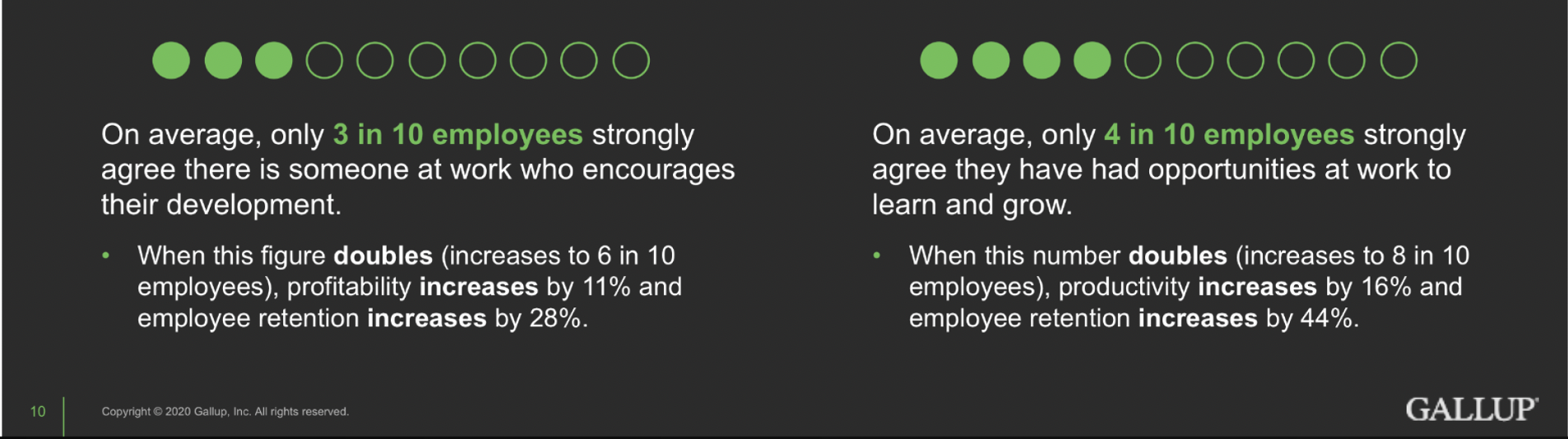
    Do you feel you are continuously developing at work? Based on research released by Gallup, I’m guessing your answer is “not really.” Below are two of their findings I thought you might find helpful.

     Regardless of whether you are a solo entrepreneur or an employee at a company, based on the stats above, it’s pretty apparent you will need to take charge of your own development. When was the last time you took the time to think about your PERSONAL DEVELOPMENT PLAN? (Not to be confused with the often unhelpful yearly goal process companies force their employees to follow.)


    Prompts to consider for your personal development plan:

    • Where do you WANT TO BE in 5 years?

    • What do you need to INVEST in over the next 3-5 years to accomplish what matters most?

    • What SKILLS do you need to learn or improve?

    • How will you stay current on INDUSTRY TRENDS and KNOWLEDGE?

    • How can you upgrade your MINDSET? (i.e., are you still thinking small?)

    • Who can you get FEEDBACK from?

    • At the pinnacle of your career, what do you want OTHERS to say about you?


    Don’t let your career unfold without being an active participant in your development. YOU are the boss of your own development. If you are having a hard time sitting down and going meta on your career, please reach out. I would be honored to help you come up with an actionable plan and be your accountability partner.


    The intent of these emails is to provide different perspectives, ideas, and insights as you navigate the path forward for yourself, your team, your organization, and your family. If I can assist you on your path, please schedule a 20-minute call here.


    To view all previous posts and articles, visit HuWork’s publications page.


    If you were forwarded this email and would like to be on the distribution list, please email me. If you wish to unsubscribe, reply with “unsubscribe” in the subject.


    Take good care

  • Flexible Gender Styles

    Have you experienced gender stereotyping at work? I know I have, especially when I worked in male-dominated industries. I tried to work around it, sometimes adopting a style that was not authentic to me, often fumbling not knowing why I wasn’t having the impact I wanted. It’s one of the reasons I’m so passionate about helping women in the workplace be successful today.


    And I’m not saying the stereotyping happened intentionally. In fact, scientists now know that ONLY 5% OF OUR BRAIN IS USED CONSCIOUSLY while 95% of brain function is happening below the surface. And it’s the subconscious that informs us how to act. Because the stereotyping is happening at the subconscious level, WE ARE GENERALLY UNAWARE OF OUR PREJUDICES.


    What does this mean for us in the real world? People that can get OUT OF THE GENDER BOX will flourish by developing flexible skills that allow the feminine and masculine styles to emerge, depending on the situation.


    You probably already have a hunch as to which style you tend towards (masculine or feminine), but just in case, below is gender expert Betty-Ann Heggie’s quick gender-style assessment. (Note: even though there are more than 2 genders, I have not seen published research on stereotypes for other genders yet so am limiting this discussion to male and female genders.)


    Assessment directions: answer each of the questions in both sections with one of the following scores:

    Never = 1; Seldom = 2; Sometimes = 3; Often = 4; Always = 5


    Part 1:

    1.     I consider others’ needs before my own.

    2.     I listen more than I talk when in a conversation.

    3.     I go out of my way to make a relationship work.

    4.     I am adept at handling multiple things at once.

    5.     I experience others’ pain when I hear about their problems.

    6.     I pause and reflect before taking action.


    Add up your score for Part 1.


    Part 2:

    1.     I prefer to take care of myself without help from others.

    2.     I like to direct the action when working in a group.

    3.     I consider competition a motivator.

    4.     I enjoy setting goals and meeting deadlines.

    5.     I think facts are more persuasive than a story.

    6.     I am a risk-taker by nature.


    Add up your score for Part 2. If your score for Part 1 was higher, your natural approach is stronger in feminine energy. If your score for Part 2 was higher, your masculine energy is stronger.


    Were you surprised by your results? What’s interesting is that after 1400 brain MRIs in Tel Aviv, researchers found that OUR BRAINS ARE NOT GENDERED. Meaning you cannot look at a brain and know if it is male or female.


    I look forward to a day when both typical masculine and feminine styles are appreciated for the value each brings.


    My hope is that these posts help you on your path of growth. If I can assist you on your path, please schedule a 20-minute call here.


    The intent of these posts is to provide different perspectives, ideas, and insights as you navigate the path forward for yourself, your team, your organization, and your family.


    Take good care,

    Bijal