Author: admin

  • Happy New Year! Wishing you the very best in 2022

    After navigating ourselves, our families, and our clients through another year of a global pandemic and a variety of other challenges, we at HuWork are more motivated than ever about our mission to help talented people improve their results and their happiness, and to help organizations be the place those people want to work.  

    While it’s been a tough year on many levels, one recent challenge I faced was an unwanted Christmas present my older son and I received – omicron. Thankfully, I only experienced mild symptoms. I hope Santa, the universe, or whatever else you believe in brought you a better present!

    I was fortunate to be in Miami at the time, recuperating in warm weather near the ocean, but my husband was in Colorado. This was the first time since 1996 that I was not able to ring in the New Year, nor celebrate his birthday (he’s a new year’s baby) with him. A few things I reminded myself to be grateful for when I was feeling down about this separation were:

    • Time with my high school junior before he flies the coop: binge watching shows, researching colleges, planning meals

    • Time without obligations: meditating, journaling, just sitting and staring at the ocean, solo walks on the beach

    • Time to reflect on the year. Three questions I’m reflecting on are:

      • What are 3 moments that you LOVED in 2021?

      • What are 3 LESSONS you learned in 2021?

      • What BEAUTY in your life are you overlooking that you can appreciate in 2022?

    In addition, a book that helped my mindset was “Fierce Self-Compassion” by Kristin Neff. I highly recommend it.

    For anyone working with a team, another resource I recommend is our The Human FactorTM, an assessment we designed to help employees at all levels consider how human is my workplace? It is based on our experience and research showing that a workplace where mindsets, behaviors and policies that support people flourishing will have better business results and a positive impact on the world. You can use this assessment to spark new thinking and start meaningful conversations with your team. Or click here and we would be happy to set up time to chat about your results.

    The entire HuWork team wants to help our fellow humans navigate personal and professional challenges in 2022 and beyond. What questions are you reflecting on?  What challenges will you face in the New Year?

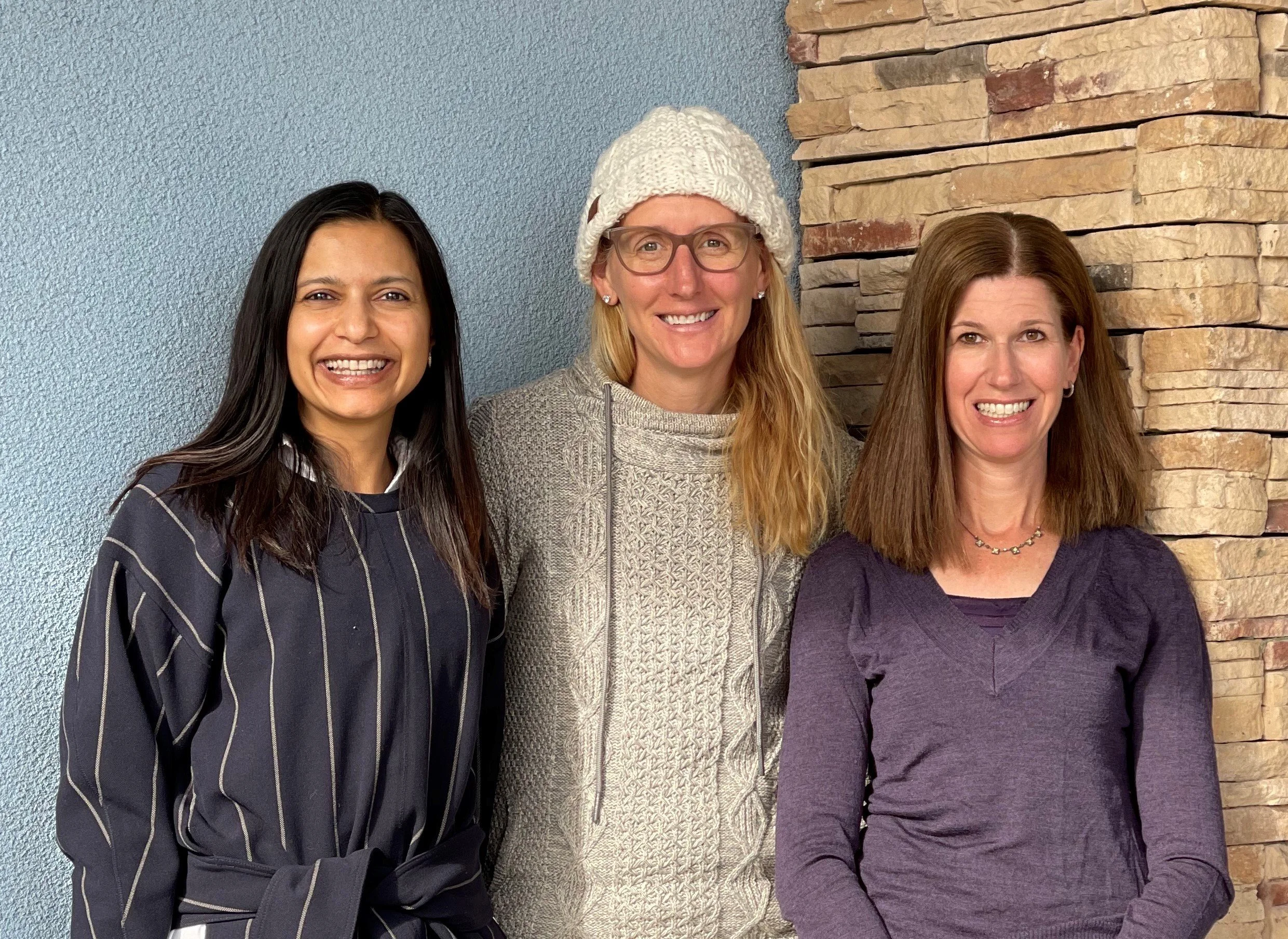
    ​​Here is a picture of me with my business partners, Liesa Wierschke Taylor and Bonnie Davis. So grateful for you both!

    Warmly, 

    Bijal

    The intent of these emails is to provide different perspectives, ideas, and insights as you navigate the path forward for yourself, your team, your organization, and your family.

    Click here if you were forwarded this email and would like to sign up to receive my emails. You may unsubscribe at any time.

    Bijal Choksi, MA, CHPC, ACC

    bijal@huworkteam.com

    Follow HuWork on LinkedIn

  • 8 types of rest this holiday

    When you hear the word REST, you may think of sleep.  And sleep indeed is important and often underappreciated. Here’s hoping we can all catch up on some sleep at the end of 2021. But have you stopped to think of other types of REST you might need, beyond the physical?

    “Rest is much more than sleep or physical relaxation” as noted on Insight Timer’s blog (Insight timer is my favorite free meditation app fyi.) Rest also includes taking a break from things every once in a while, such as from sensory overload (shopping websites, I’m talking to you!), from constantly creating or producing, from our myriad of emotions, and even from other human beings.

    The 7 types of rest included in the blog, and my addition of the 8th:

    1. Physical Rest

    2. Mental Rest

    3. Sensory Rest

    4. Creative Rest

    5. Emotional Rest

    6. Social Rest

    7. Spiritual Rest

    8. Caloric Rest: sometimes our digestive system needs a rest as well. I’m a huge fan of intermittent fasting, for its weight control but also to break up the routine of eating multiple times a day.

    With holiday gatherings in full swing, the type of rest I think I need is social. However, this Thursday would have been my dad’s 76th birthday, so I think I’ll focus on spiritual rest this week, by reconnecting with him spiritually.  

    What about you? What type of rest do you need to focus on right now?

    Warmly, 

    Bijal

    The intent of these emails is to provide different perspectives, ideas, and insights as you navigate the path forward for yourself, your team, your organization, and your family.

    Click here if you were forwarded this email and would like to sign up to receive my emails. You may unsubscribe at any time.

    Bijal Choksi, MA, CHPC, ACC

    bijal@huworkteam.com

    Follow HuWork on LinkedIn

  • Schemas: helpful and hurtful

    Being the kinda nerd that I am, I’m currently reading the PhD researcher Kristin Neff’s insightful new book, “Fierce Self-Compassion”. My latest revelation from the book is her exploration of SCHEMAS. A schema is a set of internalized detailed steps and expectations for a situation. For example, a birthday party schema will generally include some sort of invitation, food and drinks for guests, conversation, a cake, and maybe presents. Schemas can be HELPFUL in that they save our brains the time and energy of recreating a template each time.

    However, SCHEMAS CAN BE HURTFUL, especially because they operate UNCONSCIOUSLY and move us to interpret the world in a biased way, such as with gender, race, or skin color. The universe very generously (wink, wink) gave me an opportunity to experience someone else’s schema firsthand. At an educational non-profit fundraiser last week, I was about to say goodbye to the host, when an individual asked me, “What is your role at the non-profit?” After a brief pause, I responded without emotion, “Oh I don’t work for the non-profit, I’m here as a guest. But I often encounter mistakes like that because of my skin color.”  He was silent for a minute while I spoke with the host, then apologized for his bias. We ended up having a 10-minute conversation about bias, stereotypes, and how to counteract them. When I asked how I might have shown up differently, aside from my skin color, so he wouldn’t have made that assumption, he could think of nothing. His advice: continue calling people out whenever bias like this happens. 

    My skin color triggered his schema of only white people being guests at this small, intimate fundraiser. When one has a schema in play, one is much more likely to ignore or distort information to be consistent with it. The gentleman did not notice my clothes, that I was holding a cocktail glass, or that I was hugging and chatting intimately with some of the other guests. Because schemas are often unconscious, one generally does not even realize how influential they can be.

    I invite you to explore: do you have a schema that might be hurtful to others?

    Warmly, 

    Bijal

    The intent of these emails is to provide different perspectives, ideas, and insights as you navigate the path forward for yourself, your team, your organization, and your family.

    Click here if you were forwarded this email and would like to sign up to receive my emails. You may unsubscribe at any time.

    Bijal Choksi, MA, CHPC, ACC
    bijal@huworkteam.com

    Follow HuWork on LinkedIn

  • #TeamCulture

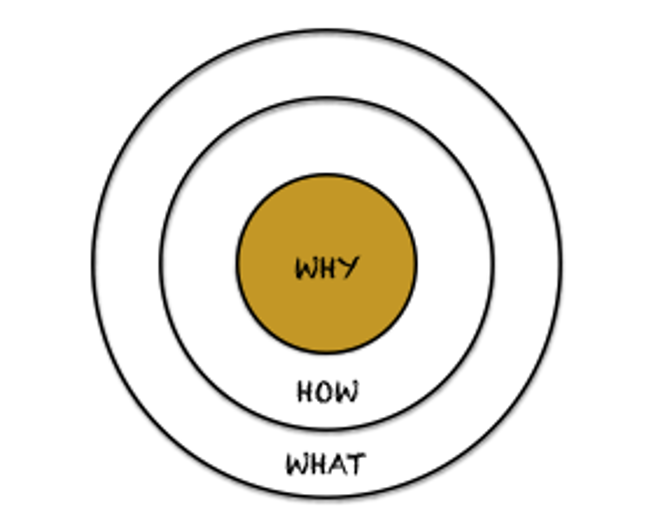
    I recently facilitated my first in-person workshop after nearly 18 months of virtual “zoomsites” and workshops. Yeehaw! (We were in Nashville.) The main theme for the leadership team was RECONNECTING with each other, but the team also wanted to RESET how they work together. To accomplish this,  we leveraged Simon Sinek’s Golden Circle concept, with the team “WHY” in the middle, followed by the “WHAT” and the “HOW”. 

    The team came up with an inspirational WHY, or purpose statement, that the rest of the department could rally around and feel proud of. Sample WHY statements include: “We accelerate the growth of our people to their full potential.” “We innovate and disrupt the status quo to bring efficiency and humanity to our customers.”

    The WHAT centered around determining 2022 priorities. But a distinguishing factor we considered was what priorities live up to the WHY statement. 

    The HOW is about the team culture, how they show up. We began by taking a real-time assessment of team dynamics using an anonymous online survey, and identified a big gap for trust and collaboration. This led to a vulnerable conversation about what steps the leadership team members could take to improve trust and collaboration. HOW do they need to show up? I asked them to come up with 5-10 hashtags that succinctly summarize their most important operating principles and values. One of them was #WeAreBetterTogether. 

    I have found that companies put so much focus on the WHAT – the projects and tasks. But not enough on the HOW – the values and culture. If you were going to craft a hashtag describing your ideal team culture, what would it be?

    Warmly, 

    Bijal

    The intent of these emails is to provide different perspectives, ideas, and insights as you navigate the path forward for yourself, your team, your organization, and your family.

    Click here if you were forwarded this email and would like to sign up to receive my emails. You may unsubscribe at any time.

    Bijal Choksi, MA, CHPC, ACC

    bijal@huworkteam.com

    Follow HuWork on LinkedIn

  • Don’t let power corrupt you

    In Harvard Business Review’s October 2021 issue, the topic of exploiting POWER was explored. This reminded me of an interview I did with UC Berkeley psychology professor Dr. Dacher Keltner when the #metoo movement was getting underway. Dr. Keltner has done extensive research on the concept of power and has published a book called “The Power Paradox”.

    What is the POWER PARADOX? It is the irony that most people gain power by advancing the interests of people within an organization or a social network, but then get sidetracked by their own DESIRES and SELF INTERESTS. This can lead to unethical, impulsive behavior that lacks empathy and humanness. In other words, they miss the fine line between using power for good, and using power for self interest.

    How does this happen? Individuals usually learn how to manage power by observing those above them. If they work for someone who often abuses power, they are more likely to end up learning those bad behaviors themselves. They may even determine that this is the new normal (sigh). 

    One idea coming out of Dr. Keltner’s book on how to counter abuse of power is to align as a team about what a CULTURE OF RESPECT really means. And I’m talking about going beyond the list of generic values, like inclusivity, on a plaque on a wall. That’s a start, but aim to get down to the actual BEHAVIORS you want to see. For example, at Kaiser Permanente these behaviors include: you don’t swear at your subordinates and you don’t interrupt them. The takeaway –  make talking about expected behaviors and use of power part of the conversation that happens at work.

    Warmly, 

    Bijal

    The intent of these emails is to provide different perspectives, ideas, and insights as you navigate the path forward for yourself, your team, your organization, and your family.

    Click here if you were forwarded this email and would like to sign up to receive my emails. You may unsubscribe at any time.

    Bijal Choksi, MA, CHPC, ACC

    bijal@huworkteam.com

    Follow HuWork on LinkedIn

  • Exploring other career options?

    According to recent statistics, 70% of the workforce is actively looking for a job change. That’s a HUGE number!

    For managers, luckily before an employee starts an active job search, there are subtle signs of disengagement:

    • Change in attitude – negativity, critical of the team/company/position

    • Change in activity – reduced productivity, different work habits

    • Breakdown in communication and/or relationships

    • Apparent complacency, lack of enthusiasm, waning commitment, withdrawn 

    If you are a leader and are beginning to notice any of these behaviors, don’t delay! Have a conversation with your employee immediately. Share some of the behaviors you have noticed and inquire as to  “what’s up?” You may also ask if they feel they are adding value, what do they need at work, what are their growth plans?

    On the flipside, if you are the person exploring other career options, I’m speaking on a career panel Tuesday, November 16 to support women who are in a job search, contemplating a career change, or feeling burnout from work/family demands of the past 18 months. You can learn more and sign up here.

    Warmly, 

    Bijal

    The intent of these emails is to provide different perspectives, ideas, and insights as you navigate the path forward for yourself, your team, your organization, and your family.

    Click here if you were forwarded this email and would like to sign up to receive my emails. You may unsubscribe at any time.

    Bijal Choksi, MA, CHPC, ACC

    bijal@huworkteam.com

    Follow HuWork on LinkedIn

  • An introvert’s lessons from glamping

    This past weekend, three friends and I went on a glamping adventure in the mountains of Colorado. For those not familiar with the term “glamping”, it’s a combination of “glamourous” and “camping”. Being an introvert on a weekend trip with extroverts provided a great opportunity to reflect on our group dynamics.

    Here are 4 team lessons this introvert learned from this glamping experiment:

    1. Know your NON-NEGOTIABLES: at its core, this is about knowing yourself. What are you open to? What makes you uncomfortable? Where are you willing to budge, and what is a hard no? E.g., you need coffee first thing in the morning, more than two drinks will leave you with a headache the next morning, subfreezing temps while sleeping is NOT okay. Next time I will reflect ahead of time on my non-negotiables and be prepared.

    2. Confirm EXPECTATIONS: four people; four different perspectives. How would we spend our time? Always together or is alone time okay? Planned or free flowing? Stay up late or take advantage of no responsibilities and maximize sleep? While some of this was “discussed” over a chat thread when sharing the weather forecast, in hindsight I might explicitly ask everyone (including myself!) what their expectations were in advance.

    3. Respect different PERSONALITIES: some people are extroverts and process through talking. Others are more reflective and might get drained with endless chatter. There were times I felt there was no space for me in the conversation, as the conversation free-associated and jumped from one person and story to the next without pause. This reminded me of “conversational equality”, a factor Google found was critical to high performing teams, where no one person dominates the conversation. For Google, this led to better ideas, execution and ultimately, outcomes.

    4. Know when to SPEAK UP: when there is no clear leader, as in a group camping trip, it is even more important for introverts to speak up when it’s important. E.g., with the extroverts caught up in a long conversation, and the sun starting to fade, making the effort to interrupt and suggest going for the hike then to take advantage of the sunlight.

    Do any of these lessons resonate with you, perhaps from a similar experience?

    Warmly, 

    Bijal

    The intent of these emails is to provide different perspectives, ideas, and insights as you navigate the path forward for yourself, your team, your organization, and your family.

    Click here if you were forwarded this email and would like to sign up to receive my emails. You may unsubscribe at any time.

    Bijal Choksi, MA, CHPC, ACC

    bijal@huworkteam.com

    Follow HuWork on LinkedIn

  • Effortless effort

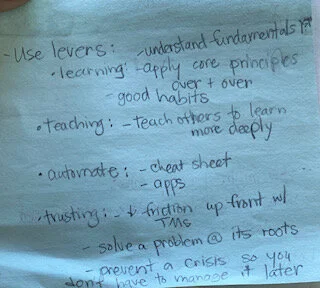
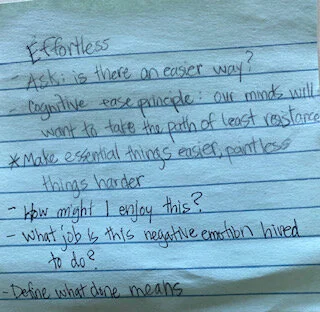
    I recently finished a book called Effortless: Make It Easier to Do What Matters Most by Greg McKeown. While finding the time to read the book did take some effort, taking time to synthesize and use the concepts is taking even more effort!

    I tried a low-tech method in response to the question, “How might I make this easier on myself?”, posed by the author. This involved using a lined post-it note to jot down key concepts, and it doubled as my bookmark. It’s not pretty, but you can see in the pictures that I was able to summarize the salient parts of the book on the sticky notes. Afterwards, it took less than a minute to take pictures of those notes and drop them into an Evernote note, for easy reference whenever needed.

    I’m currently testing out the “Automate” lever that’s on the sticky note by creating mini cheat sheets for recurring tasks. Not that I couldn’t remember the steps, but by having this cheat sheet on, you guessed it, a sticky note, it frees my mind up to be ready to make more important decisions and remember more critical information the rest of the day. 

    What is your system to document and apply what you learn from books, podcasts, or classes? I find it challenging at times to move from consumption of the material to the eventual positive impact it can have if put in place.

    Warmly, 

    Bijal

    The intent of these emails is to provide different perspectives, ideas, and insights as you navigate the path forward for yourself, your team, your organization, and your family.

    Click here if you were forwarded this email and would like to sign up to receive my emails. You may unsubscribe at any time.

    Bijal Choksi, MA, CHPC, ACC
    bijal@huworkteam.com

    Follow HuWork on LinkedIn