Author: admin

  • At A Crossroad In Your Career?

    “The greatest risk to man is not that he aims too high and misses, but that he aims too low and hits.” Michaelangelo 

    With the unemployment rate hovering around 13.5%, I know this is a tough time mentally and practically for many people. I thought it might be helpful to provide a few ideas outside of the typical job boards and recruiters. Other situations these tips may apply to: if you are running a business and are looking for more clients OR if you are having an epiphany during this time of social distancing about pivoting your career.


    • ONLINE CERTIFICATIONS: If you are in between jobs, you may want to consider getting an online certification to beef up the resume as well as keep busy. Many educational institutions are offering free or reduced programs and certifications. Universities such as Yale, Penn, and Harvard have jumped on the bandwagon. (For chuckles, check out this video by Scott Young who managed to take the entire 4-year MIT curriculum for computer science in 12 months, without taking any classes.) Since I’m a dinosaur, I was very skeptical of online learning until I tried it. I took a certification program through UC Berkeley a couple years ago and found the combination of self-paced coursework, videos, guest lecturers, and live calls with people around the world perfect to do from home. And one upside to virtual vs in-person coursework I hadn’t considered is the abundance of links to additional research, articles, TedTalks, etc. Overall, it makes for a very rich learning experience if you are self-motivated. And I can’t tell you how many clients ask about my certification in the Science of Happiness vs my Masters in Organizational Psychology, in which I invested a lot more time and money. Kind of funny.

      • BTW, if you are not self-motivated or unsure, check out Gretchen Rubin’s Four Tendencies, which will help you determine if you are motivated more by internal or external forces. It’s fascinating!

    • VOLUNTEER: This is a great way to pivot a career. I know a lawyer who was fed up with her career choice and wanted to shift to public relations. She volunteered for 3 months doing PR work for a local non-profit on the side. In return for helping a cause she believed in, she developed PR skills, made new contacts, and got a recent reference in the new field. No one asked her if it was a paid position!

      • I started and ran a nonprofit, so have lots of contacts if this is an avenue you want to explore.

    • TRADE ASSOCIATIONS: Trade associations are a great way to meet more people in a field and get exposure. If your ideal clients are in Human Resources, join a trade association for human resources. Or if you can’t join, these groups are always looking for people to present on topics of interest to the group. That’s your opportunity to build valuable contacts and start establishing yourself as an expert. They also often have recommended training programs or free webinars and networking events. 

      • Make sure you connect with everyone you meet at the trade association on LinkedIn. I found one of my business partners and many opportunities through these types of organizations.

    • SUBCONTRACT: Many companies specialize in selling projects and then scramble to find qualified subcontractors. You can help fill that gap. Reach out if you want my list of subcontracting companies.

    I encourage you to continue to aim high during these odd times. Know that you are not alone. Continue to take small steps every day. Partner with people. And take time to celebrate the small wins.

  • How Can You Be A Comforter-in-Chief?

    “We are not yet what we shall be.” These words, attributed to 16th-century theologian Martin Luther, highlight that we are all on a path of growth, that we can all strive to better ourselves.

    I had the privilege to hear Sanyin Siang, founding executive director of Duke University’s Fuqua/Coach K Leadership and Ethics Center (COLE) and a professor at Duke’s Pratt School of Engineering, speak recently on how to be a Comforter-in-Chief. (Not a typo.) Read below for more details.

    Highlights: People are experiencing sorrow over loss of loved ones, opportunities, savings, and more. Many grieve the loss of a way of life that they fear is forever gone. For the first time, individuals find themselves in the unusual role of Comforter-in-Chief. Some may argue that political and religious roles are better suited to the role of comforter. But we can all set the tone and create an environment for psychological safety, which in turn allows those around you to show up at their best.

    I encourage you to be Comforter-in-Chief of your domain – whether that’s your team, your family, or your friend group. I’ve updated my title in my phone contact, and my outbound emails now show this title as a reminder to myself. Here are Sanyin’s suggestions for how to be a Comforter-in-Chief:

    1. Lean into your discomfort. Take time to feel the ebb and flow of emotions—some of which you can’t yet name—and reflect on them. Your willingness to feel that discomfort and be vulnerable are key to your capacity to connect. You can’t be an effective comforter unless you understand what it’s like to need comfort and be comforted.

    2.  Avoid the problem-solving mindset. A fix-it attitude can’t produce words of comfort. Grief is not fixable.Rather, as Edith Cooper, who helped lead Goldman Sachs through the 2008 financial crisis as its head of human capital, says, “It’s about listening. It’s about reaching out and letting them know that you were thinking of them and then give them the space to talk about their grief.“ This is a tough one for us A-types and advisors who want to quickly move from point A to point B. But sadness and other emotions do not stem from the logical parts of our brain so approaching the situation with logic and reason and solutions isn’t always the best option.

    3. Build trust through touchstone memories. Have you encouraged and shown care so that when you reach out now, your presence can lift? And when making tough decisions, do people trust that you are doing it with greatest compassion? Trust is built in moments, and it’s never too early nor too late to create those memories.Create opportunities for celebrations so that your presence becomes a touchstone of better times past and a reminder of better days forward.

    4. Create a “battle rhythm” of communications. During World War II, King George VI’s regular addresses and President Franklin Roosevelt’s weekly fireside chats assuaged their grieving nations and inspired hope. Currently, leaders from startups to major corporations have taken to pen or video to share their personal reflections and work through their own feelings. Regular authentic communications are a source of assurance, with work colleagues, friends, and extended family.

  • Onboarding Remote Employees

    Are you onboarding new hires remotely? It’s even more important to be intentional about how you onboard employees when you can’t do it in person. Last year I wrote about the 5 things managers need to get right about onboarding. Here, updated for today’s remote environment:

    1. Connect with your employee before her first day. Send the sort of welcome letter you’d like to receive. Could be an overview of the team and challenges/opportunities, or a handwritten card expressing your enthusiasm for her start. It’s a nice touch to track down some company swag and send to her house.

    2. Ask an experienced employee to be an informal buddy. Choose someone with a keen sense of your culture and a good attitude. Not you. Encourage new hire and buddy to meet over video and ask buddy to introduce new employee to others and invite her to virtual activities. This relationship should last for the first few weeks.

    3. Provide a first-day welcome that builds community and belonging. Start with an announcement that includes her professional background + some details about her interests. Plan a virtual lunch or happy hour with the team and have everyone share their role and a few details about their lives outside of work. Then set up 1×1 video meetings where she can get to know her most important stakeholders. Debrief with her after these meetings to help her put things in context.

    4. Plan a series of learning sessions. While customer visits and site tours are out for the time being, think about the video assets you have: what’s on YouTube or your company intranet that she can watch + discuss with her buddy? Video from a recent all hands meeting? Recording of a quarterly investor call? Video of a manufacturing facility that was produced for last year’s leadership offsite? Dig up these gems to help her get the feel of the company when she can’t see things in person. Here too — don’t leave it to her to watch/read this important stuff by herself. Create a way for her to discuss with a colleague so she retains and contextualizes what she learns.

    5. Create experiences that last beyond the first day (and week). It’s impossible for people to absorb everything they need in a day or a week. Create a program that supports her through her first 3-6 months. This isn’t just a schedule of activities. Talk with her about what she observes, what she is learning, what ideas she has, and help her connect them to her role. Use your network (and your manager’s) to intentionally introduce her to people she may have met in the cafeteria, but obviously won’t meet in her own kitchen.

    Most companies haven’t done a good job onboarding employees in our normal work environment. Doing things right virtually can be a differentiator for you. Plus, as I said last year, onboarding employees in this way is simply more human: if we remove all the silly bureaucracy we have come to expect in the corporate world and imagine how we would like to be welcomed to a new group, we imagine something much closer to this than what we’re doing today.

  • Who’s The Boss Of Your Development?

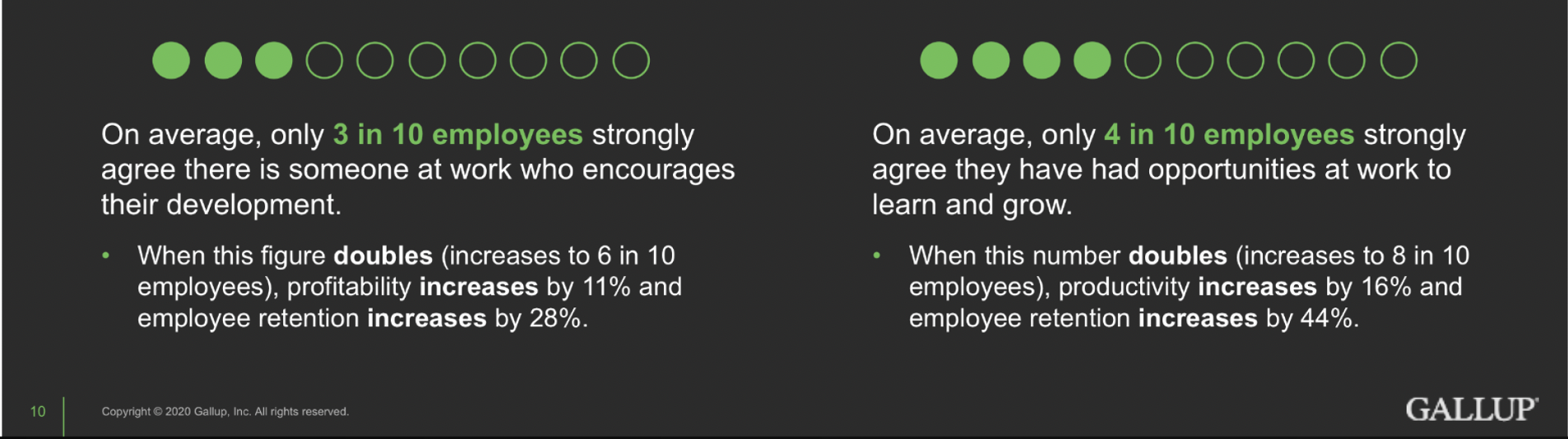
    Do you feel you are continuously developing at work? Based on research released by Gallup, I’m guessing your answer is “not really.” Below are two of their findings I thought you might find helpful.

     Regardless of whether you are a solo entrepreneur or an employee at a company, based on the stats above, it’s pretty apparent you will need to take charge of your own development. When was the last time you took the time to think about your PERSONAL DEVELOPMENT PLAN? (Not to be confused with the often unhelpful yearly goal process companies force their employees to follow.)


    Prompts to consider for your personal development plan:

    • Where do you WANT TO BE in 5 years?

    • What do you need to INVEST in over the next 3-5 years to accomplish what matters most?

    • What SKILLS do you need to learn or improve?

    • How will you stay current on INDUSTRY TRENDS and KNOWLEDGE?

    • How can you upgrade your MINDSET? (i.e., are you still thinking small?)

    • Who can you get FEEDBACK from?

    • At the pinnacle of your career, what do you want OTHERS to say about you?


    Don’t let your career unfold without being an active participant in your development. YOU are the boss of your own development. If you are having a hard time sitting down and going meta on your career, please reach out. I would be honored to help you come up with an actionable plan and be your accountability partner.


    The intent of these emails is to provide different perspectives, ideas, and insights as you navigate the path forward for yourself, your team, your organization, and your family. If I can assist you on your path, please schedule a 20-minute call here.


    To view all previous posts and articles, visit HuWork’s publications page.


    If you were forwarded this email and would like to be on the distribution list, please email me. If you wish to unsubscribe, reply with “unsubscribe” in the subject.


    Take good care

  • Future Of Work Conversations

    I previously shared a framework to encourage conversation and increase psychological safety (think: traffic lights). In a training with the Gallup organization last week, they too highlighted the importance of ongoing conversations.

    And they discussed how the topics of these work conversations are SHIFTING. Gallup highlighted six work topics that were most important to employees in the past, and what these topics will look like in the FUTURE

    A few of the items really stood out: 

    1. My Development: Employees are interested in ongoing development of skills for their specific role as always, but I’m also seeing a desire for development of the WHOLE PERSON. Skills such as how to be more resilient, less reactive, more strategic. I’m also getting requests for tools to increase SELF-AWARENESS including identification of blind spots, whether it’s through assessments, a coach, or training.


    2. My Life: Employees are conceptualizing work as part of their overall life, no longer a compartmentalized part of their day that they just “have to slog through” (in the words of a former client). Makes sense given how technology has already blurred the lines between work and life time. And now with so many people working from home, this line has been all but erased.


    Is there anything you would add to Gallup’s list of shifting conversations? What about a shift to talk about employees’ physiology, energy, and personal kryptonite so employees can show up at their best? How about employees’ well-being? Arianna Huffington’s company Thrive Global is making strides in this space, but there’s a lot more that has to be done.


    One of HuWork’s offerings is helping teams and companies develop a human-centered culture, where the whole-person is taken into account.

  • Flexible Gender Styles

    Have you experienced gender stereotyping at work? I know I have, especially when I worked in male-dominated industries. I tried to work around it, sometimes adopting a style that was not authentic to me, often fumbling not knowing why I wasn’t having the impact I wanted. It’s one of the reasons I’m so passionate about helping women in the workplace be successful today.


    And I’m not saying the stereotyping happened intentionally. In fact, scientists now know that ONLY 5% OF OUR BRAIN IS USED CONSCIOUSLY while 95% of brain function is happening below the surface. And it’s the subconscious that informs us how to act. Because the stereotyping is happening at the subconscious level, WE ARE GENERALLY UNAWARE OF OUR PREJUDICES.


    What does this mean for us in the real world? People that can get OUT OF THE GENDER BOX will flourish by developing flexible skills that allow the feminine and masculine styles to emerge, depending on the situation.


    You probably already have a hunch as to which style you tend towards (masculine or feminine), but just in case, below is gender expert Betty-Ann Heggie’s quick gender-style assessment. (Note: even though there are more than 2 genders, I have not seen published research on stereotypes for other genders yet so am limiting this discussion to male and female genders.)


    Assessment directions: answer each of the questions in both sections with one of the following scores:

    Never = 1; Seldom = 2; Sometimes = 3; Often = 4; Always = 5


    Part 1:

    1.     I consider others’ needs before my own.

    2.     I listen more than I talk when in a conversation.

    3.     I go out of my way to make a relationship work.

    4.     I am adept at handling multiple things at once.

    5.     I experience others’ pain when I hear about their problems.

    6.     I pause and reflect before taking action.


    Add up your score for Part 1.


    Part 2:

    1.     I prefer to take care of myself without help from others.

    2.     I like to direct the action when working in a group.

    3.     I consider competition a motivator.

    4.     I enjoy setting goals and meeting deadlines.

    5.     I think facts are more persuasive than a story.

    6.     I am a risk-taker by nature.


    Add up your score for Part 2. If your score for Part 1 was higher, your natural approach is stronger in feminine energy. If your score for Part 2 was higher, your masculine energy is stronger.


    Were you surprised by your results? What’s interesting is that after 1400 brain MRIs in Tel Aviv, researchers found that OUR BRAINS ARE NOT GENDERED. Meaning you cannot look at a brain and know if it is male or female.


    I look forward to a day when both typical masculine and feminine styles are appreciated for the value each brings.


    My hope is that these posts help you on your path of growth. If I can assist you on your path, please schedule a 20-minute call here.


    The intent of these posts is to provide different perspectives, ideas, and insights as you navigate the path forward for yourself, your team, your organization, and your family.


    Take good care,

    Bijal

  • Upside of stress?

    We are all familiar with the dark side of stress: tight shoulders, trouble sleeping, emotional reactivity, etc., etc…but have you stopped to consider the potential BENEFITS of stress and disruption (cough “pandemic”, “societal unrest”, “social distancing”, “job loss”)? Jonathan Haidt is a social psychologist who studies exactly this phenomenon.

    While no one enjoys the struggle, I’m glad researchers are exploring the flip side of the coin to find some upside to adversity.

    The key takeaway from Jonathan is that we rarely return to our normal ways of being and behaving after a truly difficult situation. Instead we go BEYOND that…growing and learning new ways to cope…indeed new ways of being in our life.


    Based on Jonathan’s research, I invite you to take 10 minutes to:

    1)     Think about how you might have GROWN these past few months. A few ideas to get you started: developed increased flexibility with where and how you work, started new rituals for yourself, focused more on the positive, realized you could use more sleep than you used to get, are more open to different perspectives, learned how to make a latte.


    2)     Then DOCUMENT this growth somewhere. Either in a physical journal or I’m currently loving the online and FREE tool Trello which allows you to create a virtual board you can view on your phone and computer. You could create a board called “Growth” then populate it with items as you think of them.


    3)     Lastly, CELEBRATE the growth. Doesn’t have to be anything fancy (but it can be! I encourage you to go big if you’re in the mood!). But take at least a moment to recognize your effort and growth.


    In this manner you “get to write the ending” in the words of Brene Brown, and you can bounce back not just to where you were before, but to a place of greater strength. Please share your growth list with me in the comment section below. I am trying out a new format for these posts and would love to virtually celebrate and do a happy dance with you! 

    My hope is that these posts help you on your path of growth. If I can assist you on your path, professionally or personally, please schedule a 20-minute “are we a good fit?” call here.

    The intent of these posts is to provide different perspectives, ideas, and insights as you navigate the path forward for yourself, your team, your organization, and your family.


  • Framework To Encourage Conversation

    Today’s post will highlight a framework to encourage input, conversation, and openness. It is a coaching tool developed by Shooksvenson for goals, but I have found their “Be SAFE & Certain” model utilizing the concept of red and green traffic lights helpful for encouraging open dialogue at work and in everyday life.

    Highlights of the “Be SAFE & Certain” Traffic Light framework:

    • Overview: If someone does not feel comfortable sharing their opinion at work, talking in a meeting, connecting with someone in life, that person is feeling a red light. A red light tells our brains to STOP…stop engaging, stop participating. Our collective goal is to get these 6 traffic lights GREEN to keep engagement high.

    • Process: If someone is not engaging, take a moment to mentally check in with each light in the framework:

      • Belonging: is she worried she may be rejected from the group if she doesn’t go along with what is being said?

      • Status: will speaking up lead to a role or position that does not feel right to her?

      • Autonomy: does she feel she has no control in the group?

      • Fairness: is she feeling any unfairness in the group?

      • Expectations: is she dreading something related to the group?

      • Certainty: is the group unpredictable?


    Test it with yourself: next time you are in a group setting and you are not really engaged (assuming it’s not just a boring topic or group of people), run through the 6 lights to determine if one is red for you.Once identified, how might you shift that light to green? You may need to have a hard conversation, you may want to shift a long-standing belief, or take some other action specific to your situation.


    You may also notice a trend, where one or two traffic lights turn red quite often for you. Belonging often comes up for me, so I know my team will get the best from me if I get to know and connect with each person outside of team situations to turn that light from red to green. Would love to hear what lights turn red for you regularly, and what you will do to counteract it.


    I hope you found the framework helpful. If I can assist you on your path, professionally or personally, please schedule a 20-minute “are we a good fit?” call here


    In response to people who asked to hear my stories of bias, while it is emotional for me to relive, in a spirit of open dialogue and what I committed to last week, let’s talk over a video call. Let me know which day/time works best for you in this doodle survey.

  • Starting A New Role Or Gig?

    It’s shocking to hear that forty-two million Americans lost their jobs this year. But I’ve also been hearing from many of you who are contemplating starting new jobs or gigs. Last week, I attended a Wharton webinar titled “Leadership in the Wake of COVID-19: What Enterprise Leaders Will Need to Survive and Prosper in the Years Ahead”, and there were some nuggets in there for all of us, regardless of role.

    Lori Ryerkerk, chairman, president and CEO of Celanese Corporation spoke about the importance of first impressions and of human connection when first starting in a new role. I would say this applies to new clients, projects, and co-workers as well.

    Highlights:

    • Spend the first hundred days getting to know people. Get to know the company. Talk to people, talk to customers, talk to suppliers. Lori emphasized keeping your mouth shut and hearing what everybody else has to say.


    • Really understand the entirety of the landscape, not just the technical work. Understand the social situation, the community situation, the reputational situation. Immerse yourself and learn from others. If you don’t take time to do this when you join a company, you really can make some big missteps early on that you will spend the next five years trying to recover from.


    Would love to hear what has helped you be successful when you have started a new job or project.


    And as a follow up to my last email, thank you to everyone who shared their racial bias assessment results with me – hard to own I know. And for those that shared their list of what they commit to – you are brave and know that I will support you to the best of my ability on your path. 


    In response to people who asked to hear my stories of bias, while it is emotional for me to relive, in a spirit of open dialogue and what I committed to last week, let’s talk over a video call. Let me know which day/time works best for you in this doodle survey.


    If I can assist you on your path, professionally or personally, please schedule time with me here.

  • Reflecting On Implicit Bias

    We suffer because we forget our belonging to one another.” – Mother Theresa

    This week’s theme has been REFLECTION, and I find myself drawn to reflecting on the implicit bias that I’m saddened is still prevalent in our society today. Growing up, even in New York, I felt this bias daily if not hourly ANY TIME I was out of my home. I could share a lifetime of memories and stories starting when I was five all the way up to last week. From the educational system to the workplace, it was like the low hum of an air-conditioning unit in the background – always present when you notice it. My history is one of the reasons I am so passionate about helping women and people of color compensate for this cultural bias in the work that I do.


    This isn’t their problem. This isn’t my problem. This is your problem because it’s everyone’s problem.


    This is the time to come together, to dialogue, to forge a path forward. That path becomes more intentional and I hope brighter with reflection, versus impulsive reactivity.


    Chaos is contagious, but calm is contagious too. How can you be the best version of yourself? And help others in your world?


    Which leads me to a practical framework I hope will inspire you, and that I’ve come to rely on for challenging situations:


    AWARENESS => FOCUS => REFLECTION


    • Change starts with AWARENESS: Deep reflection will bring awareness to your own biases, your values, why you feel the way you do, your judgements towards yourself and others. And if you think you are not biased, let me challenge you by asking you to take a racial bias assessment. As a woman of color, I was saddened by my score. But the org psychologist side of me knows that our habits, behaviors and biases form deeply grooved paths in our brains. Changing these pathways takes time, awareness, vigilance, and courage to face and make hard decisions every day. BUT IT STARTS WITH AWARENESS.


    • Then comes FOCUS: focused effort, focused energy towards changing the grooves that have formed in your brain with your thinking, beliefs, and habits. And as a coach, I’m always going to push you to choose COURAGE. Ask the tough questions, speak out when you see even a small racial bias in your world. Make those hard choices in everyday life to move the needle in the direction you choose. Even if your bias is not 100% removed, you can still focus and decide to make the right decision to compensate for your bias.


    • Last step is REFLECTION: Check in with yourself. How are your efforts going? What have you discovered about yourself and others? What adjustments do you need to make to fine-tune your efforts? My hope is that you feel encouraged by your actions and efforts and double down upon reflection.


    In the spirit of Mother Theresa’s quote above, here is what I commit to you:

    • I COMMIT TO: more 1:1 conversations with people who are different than me. To understand their pain, their stories, their perspectives.

    • I COMMIT TO: being courageous and speaking up with love and compassion when either I feel racial bias or see it happening to others.

    • I COMMIT TO: not shying away from difficult conversations when people ask me my opinion, even if I worry about them judging me, my experiences, and my opinions (and I’m never short on opinions!)

    • I COMMIT TO: speaking with my children openly about all types of bias, understanding their perspective, and helping them see other perspectives.


    I would love to hear what you commit to.


    I may not have gotten all the words right, but I hope you will give me grace and see my intention in writing about this.


    If I can assist you on your own path, please schedule time with me here:https://calendly.com/bijalchoksi/alliance